
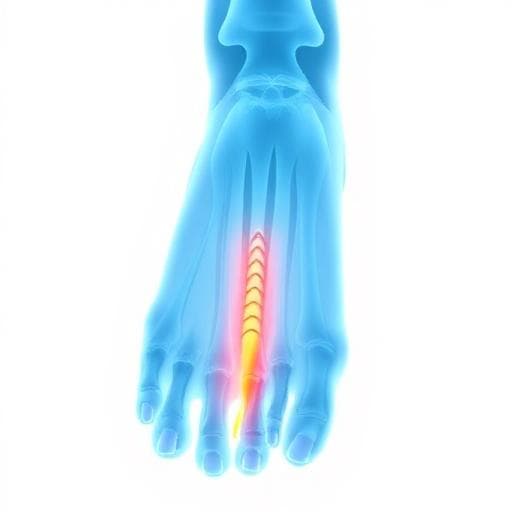





What is Morton's Neuroma?
Morton's neuroma is a painful condition caused by thickening of the tissue surrounding one of the digital nerves in the ball of your foot, most commonly between the third and fourth metatarsal heads. Despite its name, it is not a true tumour. It is a benign thickening of fibrous tissue (perineural fibrosis) that develops around the nerve in response to chronic irritation and compression.
The common plantar digital nerves travel through narrow channels between the metatarsal bones on their way to the toes. Where the nerve passes beneath the deep transverse intermetatarsal ligament, a tight band of tissue connecting the metatarsal heads, it is particularly vulnerable to compression. Repetitive loading, tight footwear, or altered foot mechanics can cause the nerve to become trapped and irritated at this point, leading to progressive fibrosis and enlargement.
As the nerve thickens, it takes up more space in an already confined area, creating a cycle of compression, irritation, and further thickening. This is why Morton's neuroma rarely resolves on its own without intervention. The mechanical problem that caused it is still present, and the structural changes in the nerve tend to progress over time.
Morton's neuroma is more than five times more common in women than men, occurs most frequently between the ages of 40 and 60, and affects the third intermetatarsal space in approximately 68% of cases, with the second space involved in most of the remainder.
Classic Symptoms
- Sharp, burning, or shooting pain in the ball of the foot, often radiating into the third and fourth toes
- Sensation of standing on a pebble, marble, or a fold in your sock
- Numbness or tingling in the affected toes
- Pain that worsens when wearing tight, narrow, or high-heeled shoes
- Pain that intensifies during walking, running, or forefoot loading
- Immediate relief when removing shoes, sitting down, or rubbing the foot
Signs You Need Specialist Assessment
- Forefoot pain persisting more than 2–3 weeks
- Numbness or altered sensation in toes that doesn't resolve
- Pain limiting your ability to walk, exercise, or wear normal footwear
- Symptoms not responding to wider shoes, rest, or pharmacy insoles
- You've been told it's Morton's neuroma but haven't had an ultrasound scan to confirm
Why Accurate Diagnosis Matters
Not all forefoot pain is Morton's neuroma, and not all Morton's neuromas cause symptoms. Research shows that thickened intermetatarsal nerves can be found on imaging in up to 30% of people with no symptoms whatsoever. Without imaging, the risk of misdiagnosis is significant.
Clinical tests for Morton's neuroma, including Mulder's click test and the thumb-index finger squeeze test, have reported accuracy of only around 62%. That means roughly 4 in 10 clinical diagnoses based on examination alone may be wrong. This is why we scan every patient with forefoot pain.
Conditions that commonly mimic Morton's neuroma:
- Intermetatarsal bursitis: Inflammation of the bursa between metatarsal heads, almost identical symptoms but looks completely different on ultrasound.
- Plantar plate tears: Fibrocartilaginous tears beneath the MTP joint causing forefoot pain and toe instability.
- Metatarsal stress fractures: Overuse fractures that can be missed without imaging.
- MTP joint synovitis: Joint capsule inflammation causing localised forefoot pain and swelling.
- Capsulitis: Inflammation of MTP joint ligaments, particularly the second, confused with nerve pathology.
How We Diagnose Morton's Neuroma
Diagnostic Ultrasound Scanning
Ultrasound is the imaging modality of choice for Morton's neuroma, the recommended first-line investigation with published sensitivity of 90–98%, matching or exceeding MRI while being performed in real time during your appointment.
- Confirming the neuroma: A well-defined hypoechoic mass in the intermetatarsal space, precisely measured in multiple planes.
- Measuring the size: Size directly influences treatment decisions. Under 5mm: conservative. Over 8–10mm: may require injection or surgical referral.
- Dynamic Mulder's manoeuvre: We watch the neuroma displacing in real time under ultrasound, far more reliable than a clinical click test alone.
- Identifying dual neuromas: Up to 16% of patients have neuromas in two intermetatarsal spaces. Clinical examination frequently misses the second.
- Ruling out mimics: Differentiating from bursitis, plantar plate tears, synovitis, and cysts on day one.
- Guiding injection therapy: Real-time needle guidance for maximum accuracy. Blind injections miss the target in a significant proportion of cases.
Pressure Plate Gait Analysis
Once we've confirmed the diagnosis, we need to understand why your nerve is being compressed. Pressure plate analysis provides objective data on forefoot force distribution during walking.
- Peak pressure zones: Exactly where maximum loading occurs under your metatarsal heads, directly informing orthotic design.
- Metatarsal loading patterns: Quantifying imbalance when one or two metatarsals bear disproportionate force.
- Forefoot width and splay: Measuring whether restricted splay narrows the intermetatarsal space.
- Timing of loading: Prolonged forefoot contact time means more nerve compression per step.
- Gait compensations: Identifying unconscious walking changes that may cause secondary problems.
Clinical Biomechanical Assessment
Thorough hands-on examination including MTP joint stability and range of motion, forefoot alignment, assessment of associated deformities (bunions, hammer toes), toe grip strength, intrinsic muscle function, ankle and first MTP joint dorsiflexion, and detailed footwear review of the shoes you actually wear day-to-day.
Treatment Options
Footwear Modification
Custom 3D-Printed Orthotics
Ultrasound-Guided Injection
Mobilisation & Rehabilitation
Surgical Referral
Common Causes & Risk Factors
Footwear
Foot Structure
Activity
Biomechanical
What to Expect at Your First Appointment
Your story
5 minClinical examination
5 minDiagnostic ultrasound
10 minPressure plate analysis
5 minDiagnosis & treatment plan
5 minRecovery & Prognosis
The prognosis for Morton's neuroma is generally very good when correctly diagnosed and managed appropriately. With conservative treatment (footwear modification and orthotics), many patients experience significant improvement within 4–8 weeks.
When combined with ultrasound-guided injection, published evidence shows substantial pain reduction in the majority of patients, with many studies reporting that minimally invasive ultrasound-guided treatments significantly reduce the need for surgery. As with most musculoskeletal conditions, early intervention produces the best outcomes.
Your Clinicians
Paul McMullan BSc(Hons) MSc FRCPSGlasg MRCPod leads the specialist forefoot pain service. Paul holds a Master's degree in Podiatric Sports Medicine from Queen Mary University of London and is a Fellow of the Royal College of Physicians and Surgeons of Glasgow, one of very few podiatrists in Northern Ireland with this distinction. With over 15 years of clinical experience and advanced training in diagnostic musculoskeletal ultrasound and injection therapy, Paul brings MSc-level expertise to every consultation.
Darren Costello BSc(Hons) MSc PGCert MRCPSGlasg HCPC MRCPod is a specialist podiatrist with a particular focus on sports podiatry, biomechanics, and ultrasound imaging. Darren holds an MSc in Sports and Exercise Medicine from Ulster University and a Postgraduate Certificate in Lower Limb MSK Ultrasonography from Brunel University London. His research background includes investigating the impact of taping on gait and plantar fascia structure, reflecting his commitment to evidence-based practice.
Having two MSc-qualified clinicians trained in diagnostic ultrasound means shorter waiting times for specialist assessment and the ability to discuss complex cases collaboratively.
Why Patients Choose Lower Limb Clinic
Diagnostic ultrasound in every assessment
Ultrasound-guided injections as standard
Pressure plate gait analysis
In-house orthotic manufacturing
MSc-level clinical expertise
700+ five-star Google reviews
Frequently Asked Questions
Common questions about Morton's Neuroma at Lower Limb Clinic.

Clinically reviewed by Paul McMullan, BSc(Hons) MSc FRCPSGlasg MRCPod
BSc (Hons) Podiatry · MSc Podiatric Sports Medicine (QMUL) · FRCPSGlasg · MRCPod
Lead Podiatrist & Clinical Director, Lower Limb Clinic Belfast