
What is a Plantar Plate Tear?
The plantar plate is a thick, strong band of fibrocartilage on the underside of each lesser toe joint (the metatarsophalangeal, or MTP, joints). It is the main stabiliser of the joint. It holds the toe down against the ground, stops it bending too far upwards, and resists the repeated load of every step. When it tears or stretches, the joint loses its key support.
Plantar plate tears most commonly affect the second toe, where the joint is loaded hardest, and occasionally the third. They usually develop gradually from chronic overload rather than a single injury, although a sudden hyperextension force can also cause one. Early on, the plate becomes inflamed and attenuated (a stage often called pre-dislocation syndrome). Over time, a partial tear can progress to a complete tear.
As the plate fails, the toe loses its anchor. It can become unstable, lift slightly off the ground, splay away from its neighbour, or drift towards the big toe. This progression to a fixed "crossover toe" deformity is the key reason plantar plate tears should be assessed early. Caught in the partial-tear stage, the joint can usually be protected and stabilised. Once a deformity becomes fixed, treatment is more involved.
Plantar plate injuries are common, frequently underdiagnosed, and very often confused with Morton's neuroma. The two can also occur together. This is why a precise diagnosis, rather than a best guess based on symptoms alone, matters so much in the forefoot.
Classic Symptoms
- Pain directly under the ball of the foot, usually at the base of the second toe
- A feeling of walking on a marble, a pebble, or a bunched-up sock
- Swelling on the top or underside of the affected toe joint
- A toe that feels unstable, or that has started to lift, splay, or drift towards the big toe
- Pain that is worse on push-off, barefoot, or in flat flexible shoes
- A widening gap between the second and third toes (the 'V sign')
Signs You Need Specialist Assessment
- Ball-of-foot pain at a single toe joint lasting more than 2–3 weeks
- A toe that is beginning to lift, cross over, or sit out of line
- A widening gap opening up between two toes
- Pain not responding to rest, wider shoes, or pharmacy insoles
- You've been told it's a neuroma but never had an ultrasound to confirm it
Why Accurate Diagnosis Matters
Forefoot pain is one of the most commonly misdiagnosed problems in the foot. A plantar plate tear, a Morton's neuroma, and a stress fracture can all cause pain in a similar spot, yet each needs a different treatment. Getting the diagnosis wrong means treating the wrong problem, and in the case of the plantar plate it can mean missing the window to prevent a permanent toe deformity.
It also changes what we should and should not do. A steroid injection can be appropriate for some forefoot conditions, but around a plantar plate it can weaken the ligament and hasten its failure. That single distinction is a good reason not to treat forefoot pain on assumption. We scan the joint so we know exactly what we are dealing with.
Conditions that commonly mimic a plantar plate tear:
- Morton's neuroma: A thickened nerve in the web space causing burning and tingling, often coexists with plantar plate damage.
- Capsulitis of the MTP joint: Inflammation of the joint capsule and ligaments, frequently the earliest stage on the same spectrum as a plantar plate tear.
- Metatarsal stress fracture: A bone stress injury causing similar forefoot pain that can be missed without imaging.
- Freiberg's disease: Loss of blood supply to the metatarsal head, most often the second, presenting as forefoot joint pain.
- Intermetatarsal bursitis: A fluid-filled bursa between the metatarsal heads that looks completely different on ultrasound.
How We Diagnose a Plantar Plate Tear
Joint Stability Testing
The most informative clinical test for the plantar plate is the dorsal drawer test (a Lachman test for the toe). We stabilise the metatarsal and gently push the toe upwards to assess how far the joint translates and whether it reproduces your pain. A loose, unstable joint points strongly to plantar plate failure.
- Drawer (Lachman) test: Grading the degree of dorsal instability at the joint, the single most useful bedside test.
- Toe purchase: Checking whether the toe still grips the ground or has started to float.
- Alignment: Looking for early drift, splay, the V sign, or crossover towards the big toe.
- Plantar palpation: Pinpointing tenderness over the plantar plate at the base of the toe.
Diagnostic Ultrasound Scanning
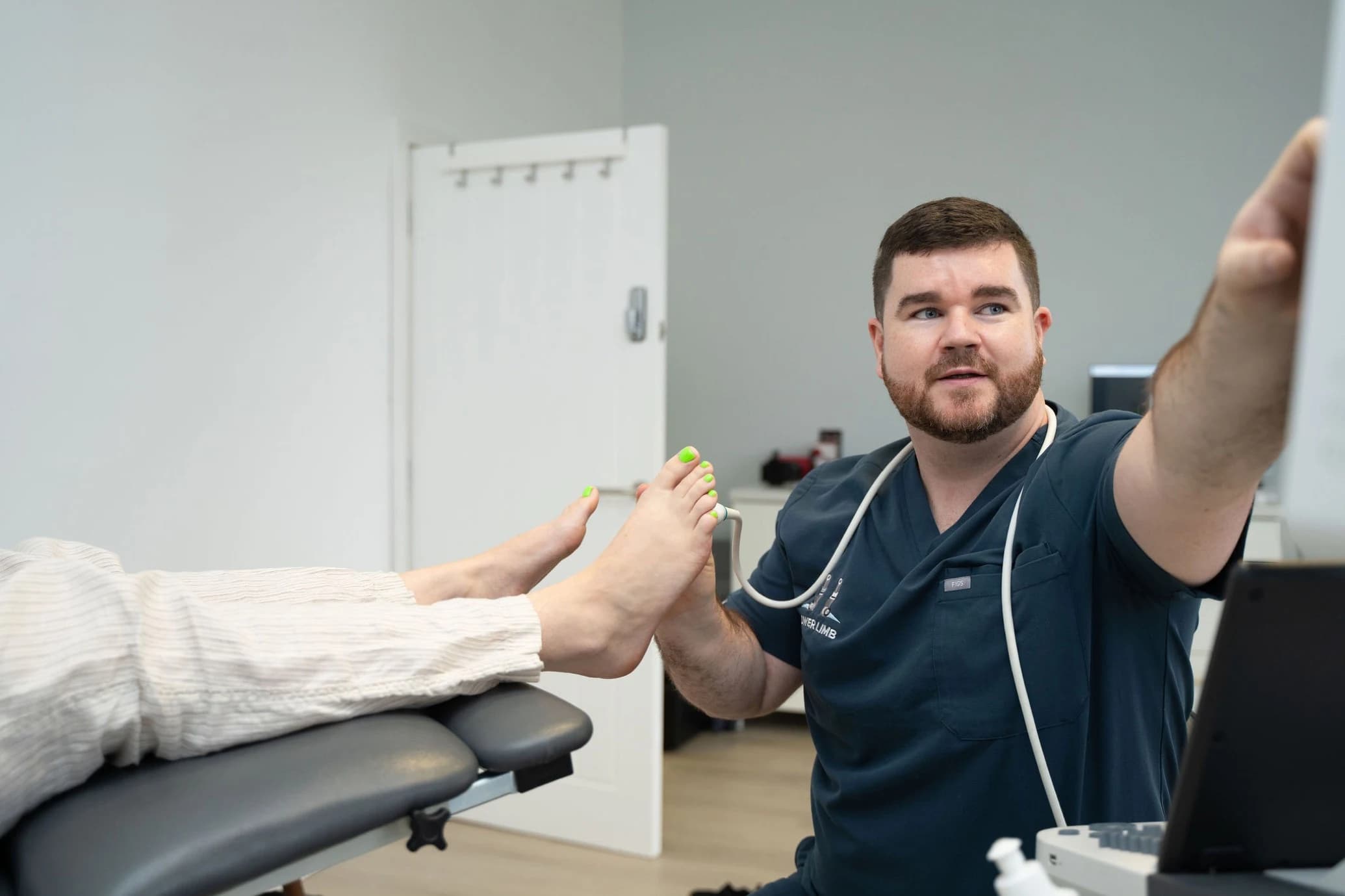
Ultrasound lets us look directly at the plantar plate and, crucially, assess it dynamically while we stress the joint. It is performed in real time during your appointment, so you get an answer on the day.
- Confirming the tear: Identifying thinning, partial tearing, or full-thickness rupture of the plate at its attachment.
- Dynamic stress assessment: Watching the joint behave under load, which a static scan cannot show.
- Ruling out the mimics: Distinguishing a tear from a neuroma, bursitis, or synovitis on day one.
- Guiding the plan: Matching treatment to whether the plate is attenuated, partially torn, or fully ruptured.
Where a complete tear or surgery is being considered, MRI and weight-bearing X-rays add further detail on grading, metatarsal length, and toe alignment. We arrange these when they will change the plan.
Pressure Plate Gait Analysis
A plantar plate rarely fails without a reason. Pressure plate analysis shows us why the joint is overloaded, which is essential for designing orthotics that actually offload it and for stopping the problem returning.
- Peak pressure zones: Where load concentrates under the metatarsal heads, often elevated under a long or overloaded second metatarsal.
- First-ray function: Whether a bunion or stiff big toe is shifting load onto the second joint.
- Forefoot loading time: How long the forefoot bears weight through each step.
Treatment Options
Plantarflexion Taping
Custom 3D-Printed Orthotics
Footwear & Rocker Soles
Rehabilitation & Calf Work
Why We Avoid Steroid Injection
Surgical Referral
Common Causes & Risk Factors
Foot Structure
Footwear
Activity & Load
Biomechanical & Other
What to Expect at Your First Appointment
Your story
5 minClinical examination
5 minDiagnostic ultrasound
10 minPressure plate analysis
5 minDiagnosis & treatment plan
5 minRecovery & Prognosis
Outcomes depend heavily on how early the tear is caught. Partial tears without a fixed deformity respond well to a structured programme of taping, custom orthotics, and footwear modification, with most people seeing meaningful improvement over roughly 8 to 12 weeks. Protecting the joint while it settles is what prevents progression.
Once the toe has crossed over into a fixed deformity, conservative care can still control symptoms but cannot straighten the toe, and surgery becomes the option for correcting it. This is why we are keen to assess these toes early. The single biggest factor in a good result is catching the tear before the deformity sets.
Your Clinicians
Paul McMullan BSc(Hons) MSc FRCPSGlasg MRCPod leads the specialist forefoot pain service. Paul holds a Master's degree in Podiatric Sports Medicine from Queen Mary University of London and is a Fellow of the Royal College of Physicians and Surgeons of Glasgow, one of very few podiatrists in Northern Ireland with this distinction. With over 15 years of clinical experience and advanced training in diagnostic musculoskeletal ultrasound, Paul brings MSc-level expertise to every consultation.
Darren Costello BSc(Hons) MSc PGCert MRCPSGlasg HCPC MRCPod is a specialist podiatrist with a particular focus on sports podiatry, biomechanics, and ultrasound imaging. Darren holds an MSc in Sports and Exercise Medicine from Ulster University and holds a Postgraduate Certificate in Lower Limb MSK Ultrasonography from Brunel University London. His research background includes investigating the impact of taping on gait and plantar fascia structure, reflecting his commitment to evidence-based practice.
Having two MSc-qualified clinicians trained in diagnostic ultrasound means shorter waiting times for specialist assessment and the ability to discuss complex cases collaboratively.
Why Patients Choose Lower Limb Clinic
Diagnostic ultrasound in every assessment
Early intervention focus
Pressure plate gait analysis
In-house orthotic manufacturing
MSc-level clinical expertise
700+ five-star Google reviews
Frequently Asked Questions
Common questions about Plantar Plate Tear at Lower Limb Clinic.

Clinically reviewed by Paul McMullan, BSc(Hons) MSc FRCPSGlasg MRCPod
BSc (Hons) Podiatry · MSc Podiatric Sports Medicine (QMUL) · FRCPSGlasg · MRCPod
Lead Podiatrist & Clinical Director, Lower Limb Clinic Belfast