
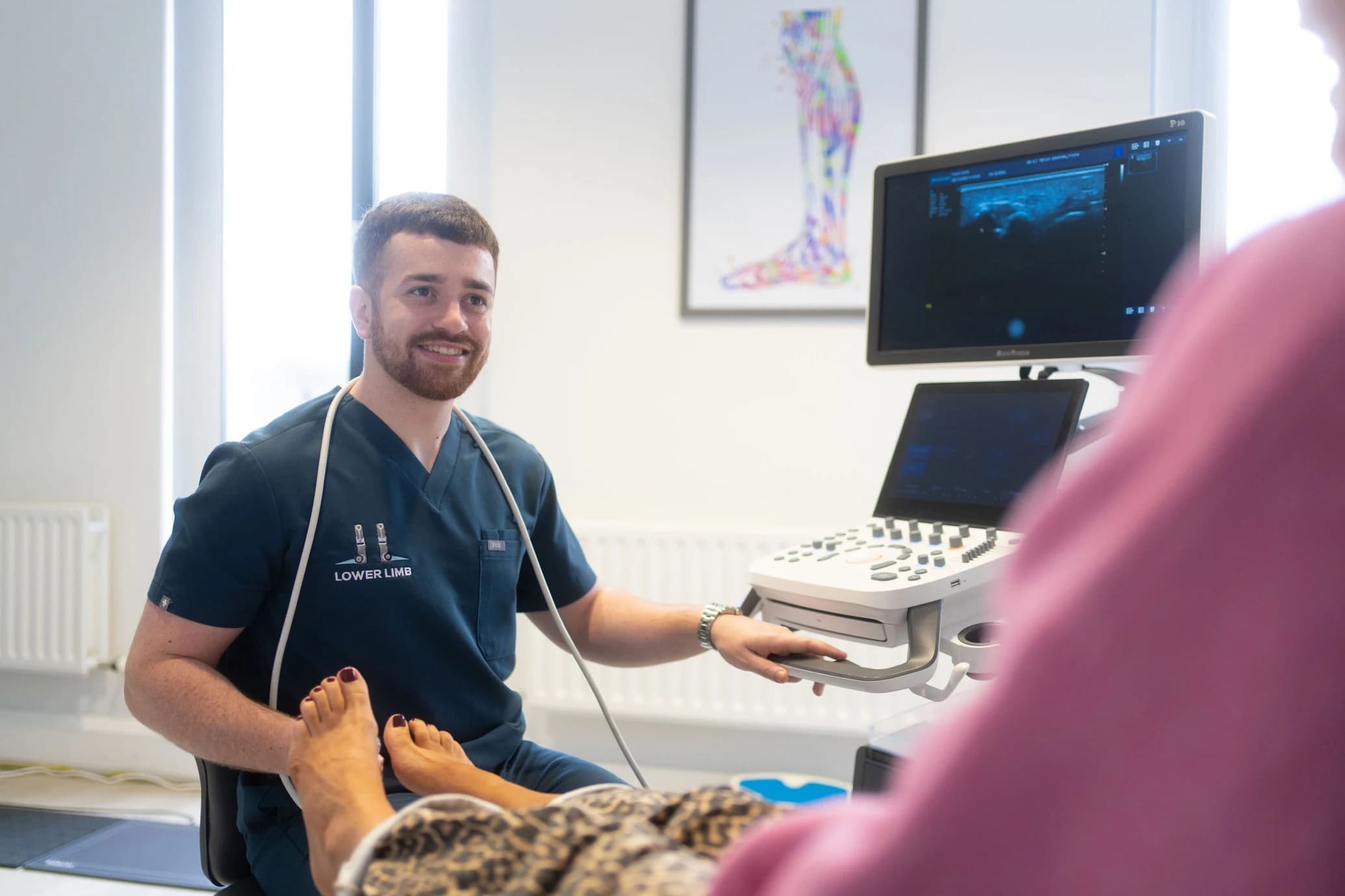





What is Diagnostic Ultrasound?
Musculoskeletal (MSK) ultrasound is a safe, non-invasive scan that uses high-frequency sound waves to produce real-time images of soft tissues: tendons, ligaments, nerves, bursae, the plantar fascia, and the fluid inside a joint. Unlike an X-ray, which shows bone, ultrasound excels at the soft-tissue structures that cause the majority of knee, foot, and ankle pain.
Its biggest advantage is that it is dynamic. We scan you in real time while you move the joint, so we can watch a tendon glide, stress a ligament, and see how a structure behaves under load. A static scan cannot do that. It means we assess function, not just anatomy.
At Lower Limb we use ultrasound as a core part of assessment rather than sending you elsewhere and waiting weeks for a report. You see the images on the screen with us, we explain what they show, and in most cases we start treatment the same day.
What We Scan
Knee
Foot
Ankle
We focus on musculoskeletal scanning of the lower limb. We do not perform abdominal, vascular, or pregnancy ultrasound.
Ultrasound or MRI?
For many soft-tissue problems in the knee, foot, and ankle, ultrasound is comparable to MRI, and for some it is the better test because it is performed in real time and assesses movement. It is also faster, lower cost, and available on the day rather than after a separate hospital appointment.
MRI still has its place. It is preferable for bone, cartilage, and structures deep within a joint. We are not here to sell you a scan for its own sake. If your problem is better answered by MRI or X-ray, we will tell you and help arrange it.
Ultrasound-Guided Injections
The same imaging that diagnoses your problem also lets us treat it accurately. When an injection is appropriate, performing it under real-time ultrasound means we watch the needle reach the exact target on screen, rather than injecting blind. Accuracy matters for both safety and results.
More about ultrasound-guided injection therapyWhat to Expect at Your Scan
Clinical assessment
5 minDiagnostic ultrasound
10–15 minDynamic testing
includedFindings & plan
5–10 minYour Clinicians
Paul McMullan BSc(Hons) MSc FRCPSGlasg MRCPod holds a Master's degree in Podiatric Sports Medicine from Queen Mary University of London and is a Fellow of the Royal College of Physicians and Surgeons of Glasgow, with advanced training in diagnostic musculoskeletal ultrasound and ultrasound-guided injection.
Darren Costello BSc(Hons) MSc PGCert MRCPSGlasg HCPC MRCPod holds an MSc in Sports and Exercise Medicine from Ulster University and holds a Postgraduate Certificate in Lower Limb MSK Ultrasonography from Brunel University London. His research has investigated the effect of taping on gait and plantar fascia structure.
Having two MSc-qualified clinicians trained in diagnostic ultrasound means short waiting times for a scan and the ability to discuss complex cases together.
Why Patients Choose Lower Limb Clinic
Diagnosis on the day
No GP referral needed
Dynamic, real-time imaging
Guided injections
MSc-level clinical expertise
700+ five-star Google reviews
Frequently Asked Questions
Common questions about Diagnostic Ultrasound at Lower Limb Clinic.

Clinically reviewed by Paul McMullan, BSc(Hons) MSc FRCPSGlasg MRCPod
BSc (Hons) Podiatry · MSc Podiatric Sports Medicine (QMUL) · FRCPSGlasg · MRCPod
Lead Podiatrist & Clinical Director, Lower Limb Clinic Belfast