
The objective testing standard used by
The philosophy
If you can't measure it, you can't manage it.
Most rehab decisions in most clinics are made on subjective judgement. "The knee feels stronger." "The shoulder seems more stable." "You're about 80% back." Those assessments have their place, but on their own they're not enough.
Objective testing closes that gap.
Every session is a data point. Every rehab decision is backed by a number you can see. When you return to sport, to running, to your life, it's because the numbers say you're ready, not because someone hopes you are.
What we measure
Four metrics that change rehab decisions.
Each rehab plan is built around real numbers you can see move week-on-week.
Newtons
Strength
Peak force produced by specific muscle groups: rotator cuff, quadriceps, hamstrings, calf, hip abductors, grip.
% difference
Asymmetry
Left-right or injured-vs-uninjured limb comparison. Target <10% before return-to-sport clearance.
W, RSImod
Power & RSI
Countermovement-jump power output and reactive strength index, measuring how explosively a limb can load and rebound.
degrees
Range of motion
Passive and active joint range measured by the DynaMo's built-in goniometer, with no more tape-measure estimates.
The systems we use
VALD ForceDecks + VALD DynaMo.
Two complementary technologies. One objective testing standard.
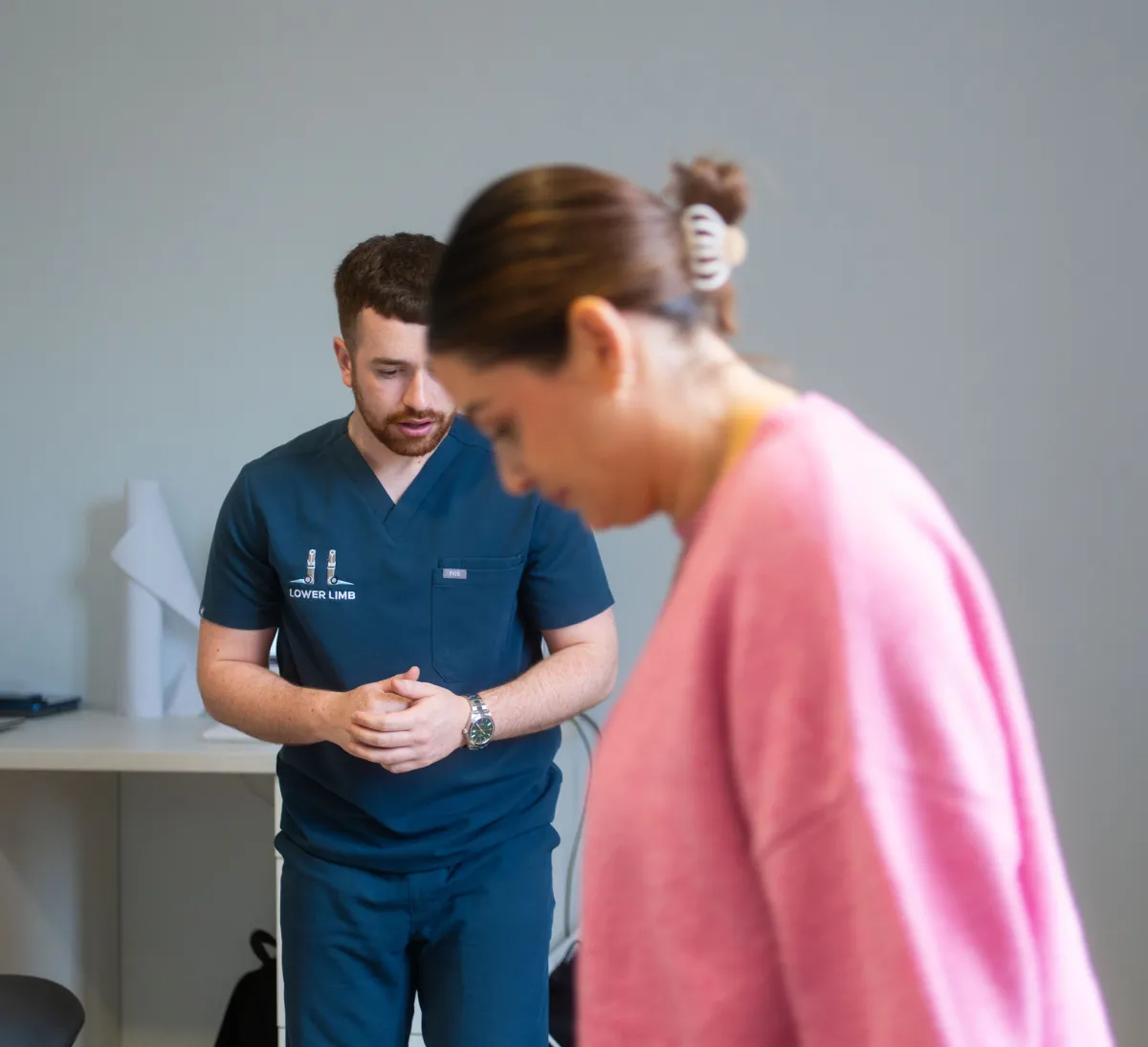
Handheld muscle dynamometry.
A precision handheld dynamometer used to test strength of specific muscle groups: rotator cuff, quadriceps, hamstrings, calf, hip, grip. The DynaMo measures peak force in Newtons, produces reliable readings clinician-to-clinician, and makes strength progress session-by-session measurable.
Where traditional manual muscle testing rates strength 0–5 on a subjective scale, DynaMo gives you the actual number, and the asymmetry between sides.
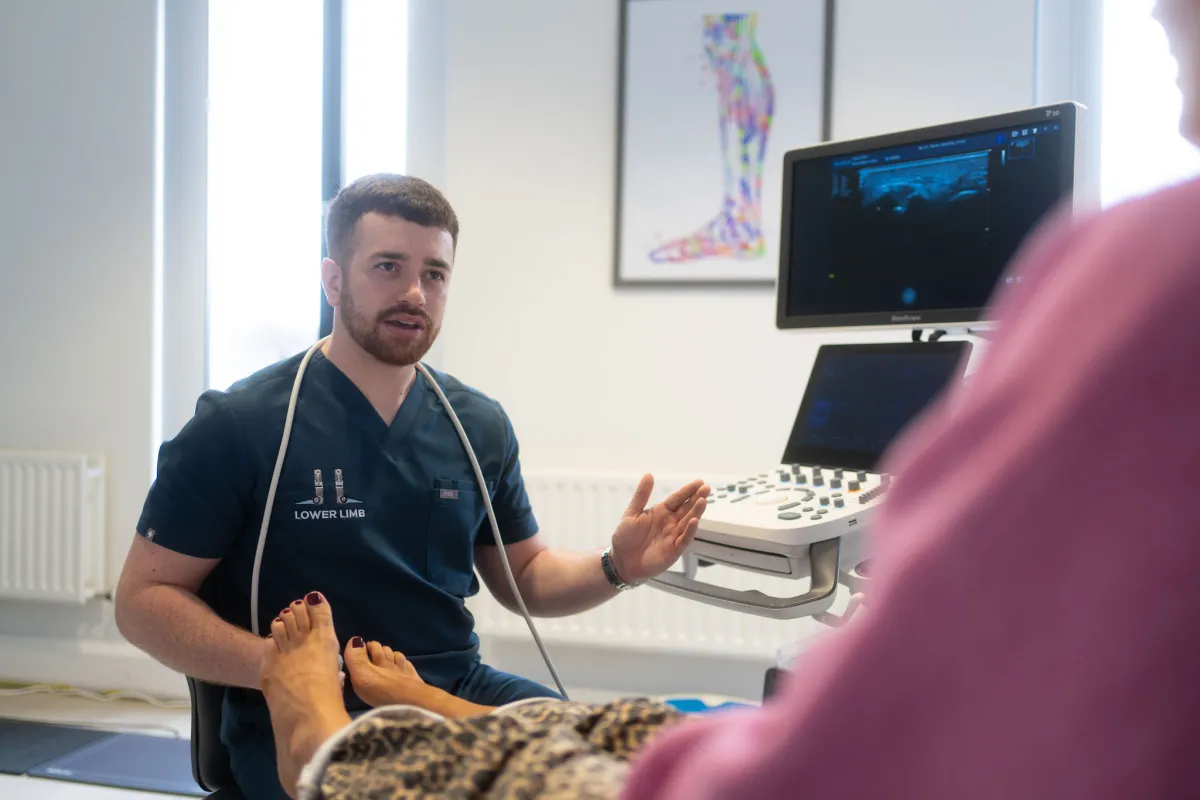
Dual force-plate testing.
Two sensitive force plates measuring ground reaction force in real time. Used to quantify jump height, jump symmetry, single-leg power, reactive strength, landing mechanics and squat force profiles, the core battery of return-to-sport testing in elite musculoskeletal practice.
This is the technology used in most major football, rugby and Olympic medical departments for lower-limb rehab decisions.
Clinical applications
Where objective testing changes the outcome.
From post-surgical rehab to return-to-sport decisions to pre-season screening, anywhere the answer needs to be a number.
ACL & knee surgery rehab
Return-to-sport testing with strict strength-symmetry criteria. Widely published benchmarks for safe return after ACL reconstruction.
Achilles tendinopathy
Calf capacity testing, seated and standing heel-raise endurance, single-leg hop testing to guide loading progression.
Rotator cuff & shoulder rehab
Internal / external rotation, abduction and grip testing to benchmark recovery after cuff tears, repair or impingement.
Return-to-sport decisions
Objective strength symmetry, jump asymmetry and hop testing replace the clinician's gut feel with measurable criteria.
Post-op hip & ankle rehab
Monitor strength recovery after hip arthroscopy, ankle fracture fixation, Achilles repair or other lower limb surgery.
Pre-season screening
Baseline strength and asymmetry profile for athletes before their competitive season, used by elite clubs worldwide.
Hamstring & groin injuries
Isometric hamstring and adductor squeeze testing, the two single best predictors of recurrence in field-sport athletes.
Objective baseline documentation
Every rehab programme starts with a measured baseline, so progress is real, recorded and defensible in medico-legal cases.
How an assessment works
Four steps. Real numbers. Clear plan.
01
Clinical assessment first
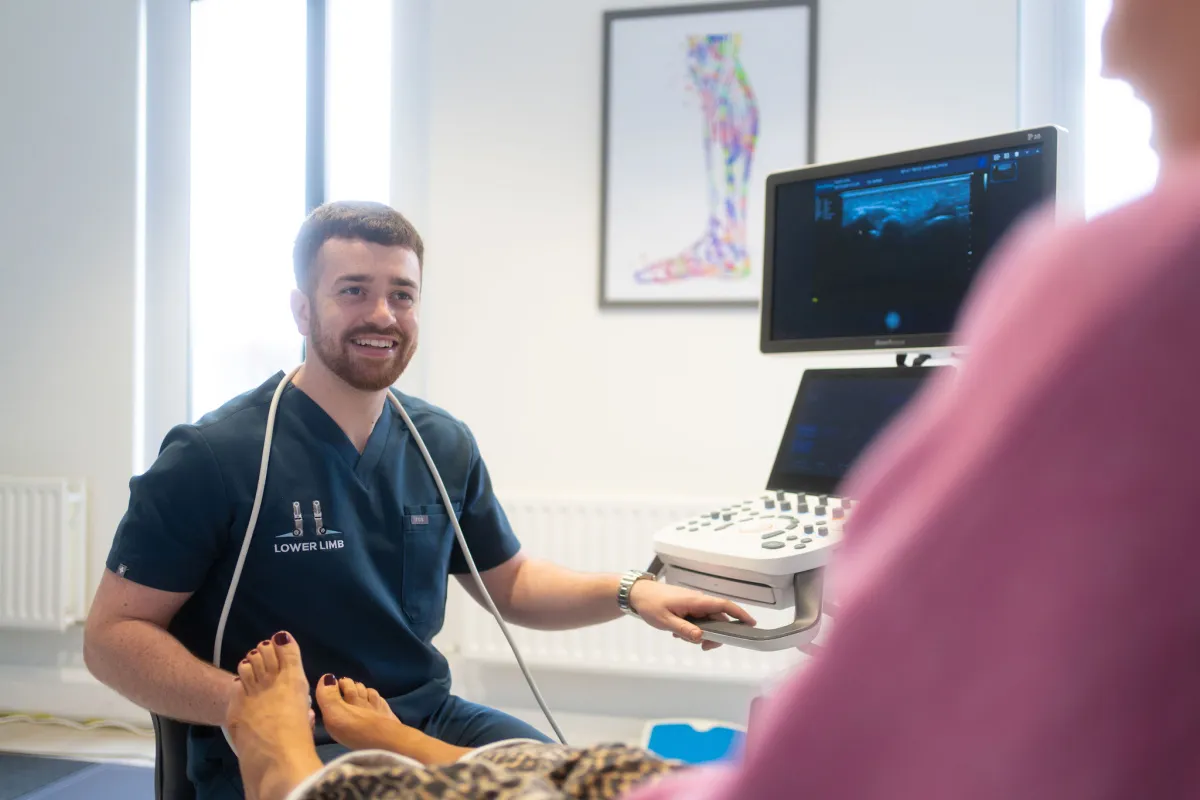
Every VALD session starts with a full musculoskeletal assessment. Diagnostic ultrasound and biomechanical examination where clinically indicated.
02
Baseline testing
We select the right test battery for your condition: isometric strength tests, hop tests, jump tests, range-of-motion. Results recorded in VALD's cloud platform.
03
Data-led rehab programme
Your results dictate the rehab plan. Deficits become specific targets. Asymmetries get written into the exercise prescription.
04
Re-test at milestones
Repeat testing at structured intervals (typically 4–6 weeks). You see the numbers move, not just feel different. Exit testing before return to sport.
The authority signal
VALD is the global objective testing standard.
Used daily by the programmes that simply can't afford to get return-to-sport decisions wrong.
Lower Limb Clinic Belfast is adopting the same testing standard, applied to the same clinical questions, for our patients in Belfast, Holywood, Bangor, Lisburn and across Northern Ireland.
Book online
Book VALD testing in Belfast.
VALD strength testing is available at Lower Limb Clinic as part of our specialist physiotherapy service. Book online in a few clicks.
Frequently Asked Questions
Common questions about VALD strength testing at Lower Limb Clinic.