
What is Ball of Foot Pain?
Ball of foot pain, known clinically as metatarsalgia, means pain under the heads of the metatarsal bones, the long bones that end just behind the toes. Most people describe an ache or a burning under the forefoot that is worse when standing, walking barefoot on hard floors, or wearing thin flat shoes or heels. Many say it feels like walking on a pebble, or as if a sock has bunched up under the foot when it has not.
The important point is that metatarsalgia is a symptom complex rather than a single condition. Several quite different problems produce pain in the same small area, and each one is treated differently. Simple mechanical overload of the metatarsal heads is the most common, but the same pain can come from a Morton's neuroma, a plantar plate tear, capsulitis of a toe joint, sesamoiditis under the big toe, a metatarsal stress fracture, or a bursa between the metatarsal heads.
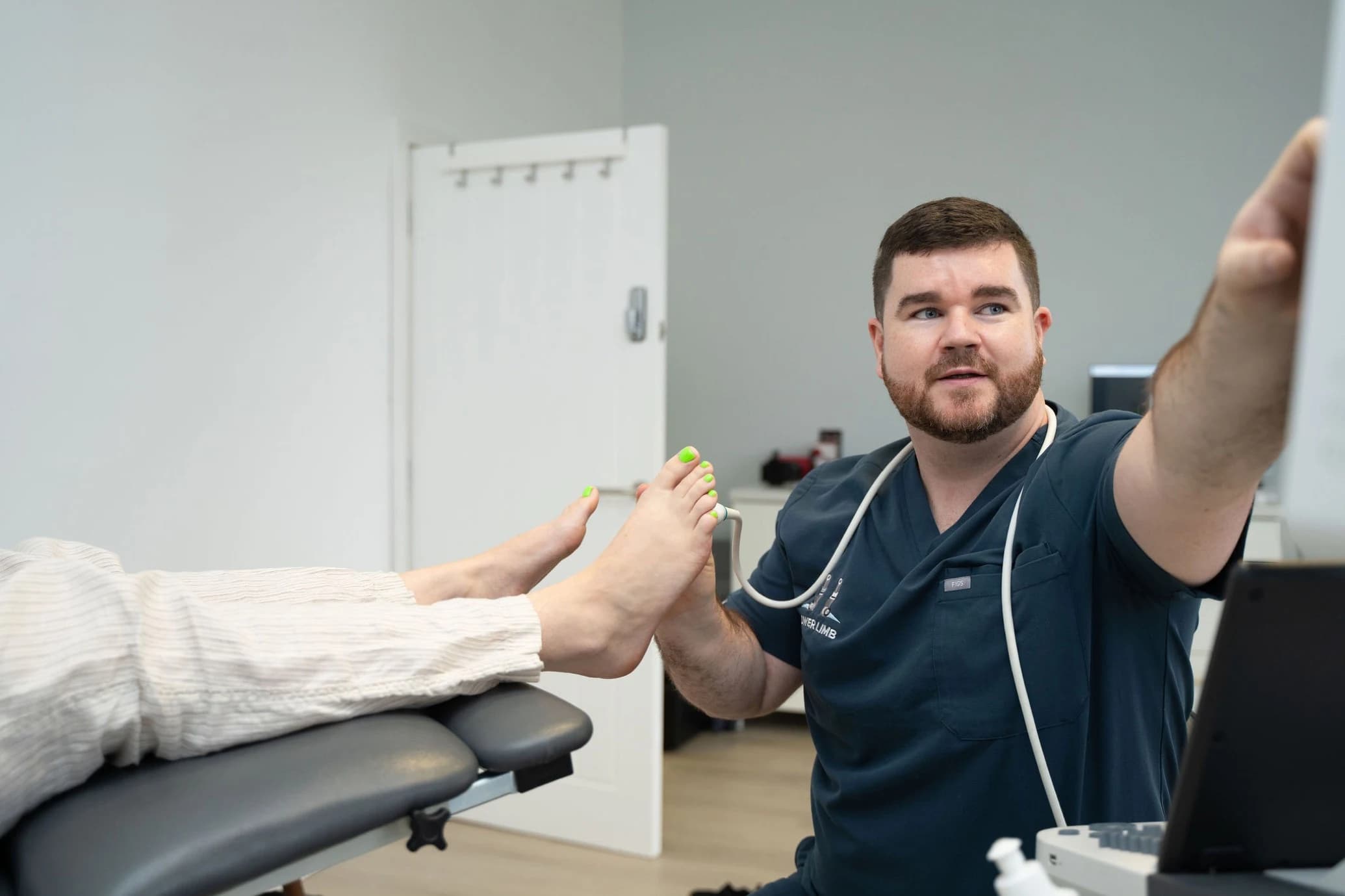
Because they overlap so much on symptoms alone, forefoot pain is one of the most frequently misdiagnosed problems in the foot. Treating a plantar plate tear as though it were a neuroma, or a stress fracture as though it were simple overload, wastes weeks and can make the problem worse. That is why our forefoot assessment always includes diagnostic ultrasound performed in the room, so you leave with a specific diagnosis rather than a label.
Common Symptoms
- Aching, burning or sharp pain under the ball of the foot, usually behind the second, third or fourth toes
- A feeling of walking on a pebble, a marble, or a bunched-up sock in your shoe
- Pain that is worse standing, walking barefoot on hard floors, or in thin flat shoes and heels
- Hard skin (callus) building up under the painful area
- Tingling, burning or numbness spreading into the toes
- Swelling on top of or under a toe joint, or a toe that has started to drift or lift
When to Get It Assessed
- Ball of foot pain lasting more than two to three weeks despite rest and wider shoes
- Pain that is pinpointed to a single spot, or that came on after a jump in activity
- Numbness or tingling in the toes
- A toe that is changing position, or a gap opening between two toes
- Pharmacy insoles or gel pads have not helped
- You have been given a diagnosis but never had the area scanned
The Common Causes, and How We Tell Them Apart
Each of these conditions can present as "pain under the ball of my foot". On examination and ultrasound they look different, and knowing which one you have determines the treatment. Where a specific diagnosis has its own page, follow the link for the detail.
- Mechanical metatarsalgia (overload): Diffuse pain under the second to fourth metatarsal heads, often with callus, driven by foot structure, footwear or a tight calf. Treated with offloading, orthotics and footwear.
- Morton's neuroma: A thickened nerve between the metatarsal heads, usually the third space. Burning or shooting pain into the toes, often relieved by taking the shoe off.
- Plantar plate tear: Damage to the ligament under a lesser toe joint, most often the second. Pain directly under the joint, a toe that feels unstable or starts to drift.
- Capsulitis: Inflammation of a toe joint capsule and its ligaments, frequently the earliest stage of plantar plate failure. Localised swelling and pain at one joint.
- Sesamoiditis: Irritation or stress injury of the two small bones under the big toe joint. Pain sits under the big toe rather than the lesser toes and is worse on push-off.
- Metatarsal stress fracture: A bone stress injury of the metatarsal shaft, usually after an increase in training. Tender over the bone rather than the joint, and easily missed on early X-ray.
- Intermetatarsal bursitis: A fluid-filled bursa between the metatarsal heads that can mimic a neuroma but looks completely different on ultrasound.
Two of these deserve a specific warning. A steroid injection can be appropriate for capsulitis, synovitis or bursitis, but around a plantar plate tear it can weaken the ligament and hasten toe deformity, and around the sesamoids it carries its own risks. Injecting the forefoot without first scanning it is a gamble we do not take.
How We Diagnose Ball of Foot Pain
Clinical Examination
We start by pinpointing exactly where the pain is and which structures reproduce it. A handful of well-validated bedside tests separate joint problems from nerve and bone problems before we even pick up the probe.
- Palpation: Locating tenderness over a metatarsal head, a joint, the shaft of the bone, or the web space between the toes.
- Dorsal drawer (Lachman) test: Assessing stability of each toe joint, the most reliable bedside sign of a plantar plate problem.
- Squeeze test and Mulder's click: Compressing the forefoot to provoke a neuroma or inflamed joint.
- Toe alignment and calf length: Looking for drift, splay, a long second metatarsal, and a tight calf that pushes load forward.
Diagnostic Ultrasound
Ultrasound is the first-line investigation for forefoot pain and we perform it during your appointment. It shows the soft tissues that X-ray cannot, and it can be done dynamically while we stress the joint.
- Neuroma or bursa: A thickened nerve looks quite different from a compressible fluid-filled bursa.
- Plantar plate: Thinning, partial tearing or rupture of the ligament under the toe joint, seen while the joint is loaded.
- Joint synovitis and effusion: Fluid and inflammation in a toe joint, and whether more than one joint is involved.
- Sesamoids and tendons: The tissue around the sesamoid bones and the flexor tendons.
Where a stress fracture, Freiberg's disease or a complete tear is suspected, we arrange X-ray or MRI. Bone problems need bone imaging, and we refer for it when it will change the plan.
Pressure Plate Gait Analysis
Ultrasound tells us what is damaged. Pressure plate analysis tells us why. It maps how load moves across your forefoot with every step, which is what we use to design an orthotic that actually offloads the painful area.
- Peak pressure zones: Where load concentrates under the metatarsal heads.
- First-ray function: Whether a stiff big toe joint or a bunion is shifting load onto the lesser toes.
- Forefoot loading time: How long the forefoot carries your weight in each step, often prolonged by a tight calf.
Treatment Options
Custom 3D-Printed Orthotics
Footwear and Rocker Soles
Offloading and Taping
Calf Stretching and Foot Strengthening
Ultrasound-Guided Injection Where Indicated
Surgical Referral
Common Causes and Risk Factors
Foot Structure
Footwear
Activity and Load
Tight Calf and Other Factors
What to Expect at Your First Appointment
Your story
5 minClinical examination
5 minDiagnostic ultrasound
10 minPressure plate analysis
5 minDiagnosis and treatment plan
5 minRecovery and Prognosis
Mild mechanical metatarsalgia usually improves within two to four weeks of the right footwear and padding, and settles fully in six to eight weeks. Moderate cases treated with custom orthotics and a calf and foot rehabilitation programme typically show clear improvement by six to eight weeks and resolve over three to four months. Wearing the orthotics and appropriate shoes every day is the single biggest factor; skipping them roughly doubles the recovery time.
Where the diagnosis turns out to be a neuroma, plantar plate tear, capsulitis, sesamoid injury or stress fracture, the timeline follows that condition. The reason we scan first is that these are the cases where guessing costs the most time. An early, specific diagnosis is what stops a straightforward forefoot problem becoming a chronic one.
Your Clinicians
Paul McMullan BSc(Hons) MSc FRCPSGlasg MRCPod leads the forefoot pain service. Paul holds a Master's degree in Podiatric Sports Medicine from Queen Mary University of London and is a Fellow of the Royal College of Physicians and Surgeons of Glasgow, one of very few podiatrists in Northern Ireland with this distinction. With over 15 years of clinical experience and advanced training in diagnostic musculoskeletal ultrasound, Paul brings MSc-level expertise to every consultation.
Darren Costello BSc(Hons) MSc PGCert MRCPSGlasg HCPC MRCPod is a specialist podiatrist with a particular focus on sports podiatry, biomechanics and ultrasound imaging. Darren holds an MSc in Sports and Exercise Medicine from Ulster University and a Postgraduate Certificate in Lower Limb MSK Ultrasonography from Brunel University London.
Having two MSc-qualified clinicians trained in diagnostic ultrasound means shorter waiting times for specialist assessment and the ability to discuss complex forefoot cases collaboratively.
Why Patients Choose Lower Limb Clinic
Diagnostic ultrasound in every forefoot assessment
Diagnosis before injection
Pressure plate gait analysis
3D-printed orthotics from our own lab
MSc-level clinical expertise
700+ five-star Google reviews
Frequently Asked Questions
Common questions about Ball of Foot Pain at Lower Limb Clinic.

Clinically reviewed by Paul McMullan, BSc(Hons) MSc FRCPSGlasg MRCPod
BSc (Hons) Podiatry · MSc Podiatric Sports Medicine (QMUL) · FRCPSGlasg · MRCPod
Lead Podiatrist & Clinical Director, Lower Limb Clinic Belfast