
What is Sesamoiditis?
The sesamoids are two small bones, each about the size of a pea, that sit under the big toe joint inside the tendon that bends the toe down. They work like a pulley, protecting the tendon and giving it leverage as you push off. Because they sit directly under the joint, they take a great deal of load with every step, and far more when you run, jump, dance or wear heels.
Sesamoiditis is irritation and inflammation of one or both sesamoids and the tissue around them. It usually comes on gradually and causes a deep ache directly under the big toe joint that is worse on push-off, barefoot, or in flexible or high-heeled shoes. The inner (tibial) sesamoid is affected far more often than the outer one.
The same area is home to several related problems that can feel very similar. A sesamoid stress fracture develops from the same repetitive load, and about nine in ten involve the inner sesamoid. Some people are born with a sesamoid in two pieces (a bipartite sesamoid), which is harmless in most but can become painful with overuse and is easily mistaken for a fracture on X-ray. Turf toe is an acute sprain of the ligaments under the joint after the toe is forced upwards, typically in field sport. In rare cases a sesamoid loses its blood supply (osteonecrosis), which is why a sesamoid that is not settling needs to be re-imaged rather than left.
Sesamoid injuries are known for healing slowly. The bones have a limited blood supply and are loaded every time you stand. Getting the diagnosis right early and offloading properly from the start is what keeps a straightforward case from becoming a chronic one.
Classic Symptoms
- Pain directly under the big toe joint, usually on the inner side of the ball of the foot
- Worse on push-off, on tiptoe, going up stairs, running or dancing
- Worse barefoot on hard floors and in flexible or high-heeled shoes
- Tender to press on one specific spot under the joint
- Pain when the big toe is bent upwards
- Sometimes swelling or bruising under the joint, particularly after a sudden injury
Signs You Need Specialist Assessment
- Pain under the big toe joint lasting more than two weeks
- Pain that came on after an increase in running, jumping or dancing
- A sudden injury where the toe was forced upwards, with swelling or bruising
- Pain that is not improving despite rest and stiffer shoes, or is getting worse
- You have been told it is sesamoiditis but it has never been imaged
Why Accurate Diagnosis Matters
Sesamoiditis, a sesamoid stress fracture, a painful bipartite sesamoid and early osteonecrosis all present as pain under the big toe joint, and they overlap considerably. The management principles are similar in the early phase, but the timelines, the degree of protection needed, and the decision about when to re-image are different. A stress fracture that is treated as simple inflammation, and loaded too early, can progress to delayed healing, non-union and loss of blood supply to the bone.
Diagnosis also changes what we should not do. Corticosteroid injection near the sesamoids carries specific risks, including damage to the fat pad that cushions them and, in a bone that already has a fragile blood supply, a small but real risk of osteonecrosis. It should never be given without first excluding a fracture. Knowing what is under the joint before treating it is not optional here.
Conditions that commonly mimic sesamoiditis:
- Sesamoid stress fracture: Same location and mechanism, but a bone injury that needs longer, stricter offloading and imaging to confirm healing.
- Symptomatic bipartite sesamoid: A two-part sesamoid that has become painful with overuse. Looks like a fracture on X-ray to the untrained eye.
- Turf toe: An acute sprain of the ligaments and plantar plate under the joint after a forced upward bend, graded by severity.
- Hallux rigidus: Arthritis of the big toe joint itself. Pain and a bump on top of the joint, with loss of movement.
- Flexor tendon or bursa problems: Inflammation of the tendon that runs past the sesamoids, or of a bursa under the joint, both visible on ultrasound.
How We Diagnose Sesamoid Pain
Clinical Examination
The sesamoids can be examined precisely, and a careful examination usually tells us which one is involved and how irritable it is.
- Direct palpation: Pinpointing tenderness over the inner or outer sesamoid, and comparing the two.
- Passive dorsiflexion: Bending the toe upwards to load the sesamoid apparatus. Pain at the end of range is highly suggestive.
- Resisted plantarflexion: Asking the toe to push down against resistance, which loads the sesamoids through the tendon.
- Sesamoid glide and gait: How freely the sesamoids move, and whether you are avoiding push-off or rolling to the outside of the foot.
Diagnostic Ultrasound
Ultrasound is performed during your appointment and gives a real-time view of the soft tissue around the sesamoids: the tendon that runs past them, the plantar plate, the joint capsule and any bursa. It is also how we guide an injection if one is ever indicated.
- Soft-tissue inflammation: Swelling around the sesamoid, tendon irritation, bursitis and joint effusion.
- Plantar plate and capsule: Particularly important after a turf toe injury, to assess how much of the plantar complex is damaged.
- Ruling out the mimics: Distinguishing a sesamoid problem from a joint or tendon problem on the day.
Ultrasound cannot see inside bone. If a stress fracture, bipartite sesamoid or osteonecrosis is suspected, we refer for the right imaging: X-rays including a dedicated axial sesamoid view, and MRI where the diagnosis is uncertain or the sesamoid is not settling. Bone problems need bone imaging, and we arrange it rather than guess.
Pressure Plate Gait Analysis
Sesamoid overload has a mechanical reason, and pressure plate analysis shows us what it is. It also confirms, once orthotics are in, that the sesamoids are actually being offloaded rather than just cushioned.
- First metatarsal head loading: How much of your body weight goes through the sesamoids at push-off.
- Foot type: A high-arched foot or one that rolls in heavily both concentrate load medially.
- Compensation: Whether you have started avoiding the big toe and shifting load elsewhere.
Treatment Options
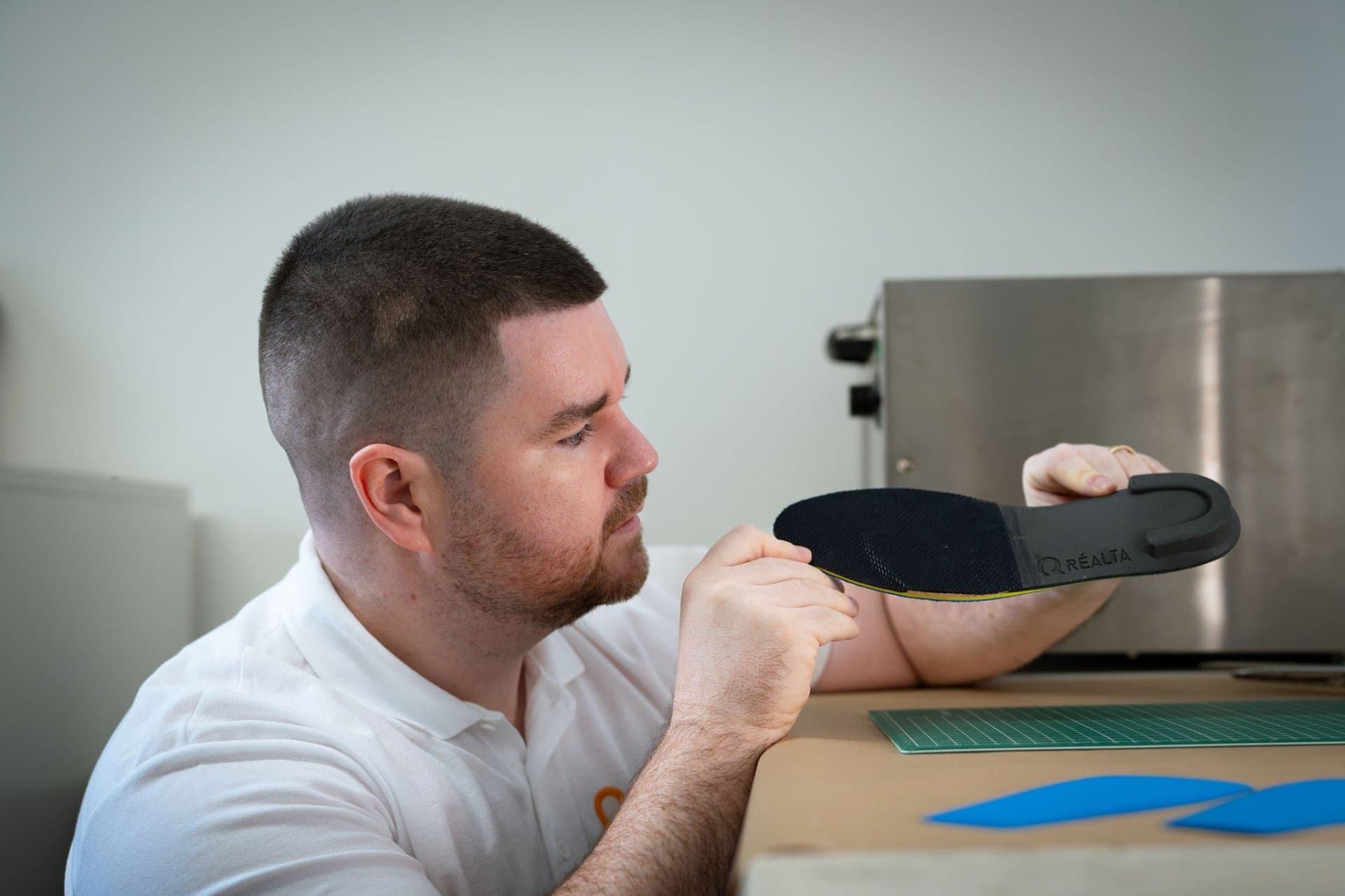
Custom 3D-Printed Offloading Orthotics
Immediate Offloading and Protection
Footwear and Rocker Soles
Activity Modification and Rehabilitation
Shockwave Therapy for Chronic Cases
Injection: Only Where Indicated
Surgical Referral
Common Causes and Risk Factors
Activity
Foot Structure
Footwear
Injury and Anatomy
What to Expect at Your First Appointment
Your story
5 minClinical examination
5 minDiagnostic ultrasound
10 minPressure plate analysis
5 minDiagnosis and treatment plan
5 minRecovery and Prognosis
Mild sesamoiditis usually eases within two to three weeks of proper offloading and settles over six to eight weeks. Chronic or moderate cases take longer, typically three to six months, and need offloading maintained throughout. An uncomplicated sesamoid stress fracture takes six to twelve weeks with strict protection, longer if healing is delayed, and is re-imaged at six to eight weeks to confirm it is progressing. A painful bipartite sesamoid usually responds well to offloading within six to twelve weeks. Turf toe ranges from a few days for a mild sprain to several months for a complete tear.
The honest message is that sesamoid problems are slow. Poor blood supply and constant loading mean three to six months is normal, not a sign that something has gone wrong. Rushing back is what turns a stress reaction into a fracture, and a fracture into a non-union. Wearing the orthotics in every shoe, respecting the activity restrictions, and re-imaging when a sesamoid is not settling are what get you back to full activity, and for most people they do.
Your Clinicians
Paul McMullan BSc(Hons) MSc FRCPSGlasg MRCPod leads the forefoot and sesamoid service. Paul holds a Master's degree in Podiatric Sports Medicine from Queen Mary University of London and is a Fellow of the Royal College of Physicians and Surgeons of Glasgow, one of very few podiatrists in Northern Ireland with this distinction. With over 15 years of clinical experience and advanced training in diagnostic musculoskeletal ultrasound, Paul brings MSc-level expertise to every consultation.
Darren Costello BSc(Hons) MSc PGCert MRCPSGlasg HCPC MRCPod is a specialist podiatrist with a particular focus on sports podiatry, biomechanics and ultrasound imaging. Darren holds an MSc in Sports and Exercise Medicine from Ulster University and a Postgraduate Certificate in Lower Limb MSK Ultrasonography from Brunel University London.
Having two MSc-qualified clinicians trained in diagnostic ultrasound means shorter waiting times for specialist assessment and the ability to discuss complex cases collaboratively.
Why Patients Choose Lower Limb Clinic
Sesamoid pain is a specialist interest
Diagnostic ultrasound on site
Offloading orthotics from our own lab
Pressure plate gait analysis
MSc-level clinical expertise
700+ five-star Google reviews
Frequently Asked Questions
Common questions about Sesamoiditis at Lower Limb Clinic.

Clinically reviewed by Paul McMullan, BSc(Hons) MSc FRCPSGlasg MRCPod
BSc (Hons) Podiatry · MSc Podiatric Sports Medicine (QMUL) · FRCPSGlasg · MRCPod
Lead Podiatrist & Clinical Director, Lower Limb Clinic Belfast