
What is Hallux Rigidus?
Hallux rigidus is osteoarthritis of the big toe joint (the first metatarsophalangeal, or MTP, joint). It is the second most common problem affecting the big toe after bunions, and it affects roughly one in forty people over the age of fifty. It is more common in women and is present in both feet in most cases.
The condition sits on a spectrum. In the early stage, called hallux limitus, the joint still moves reasonably well but is stiff and sore at the end of its range, particularly on push-off. As the cartilage wears and bone spurs (osteophytes) build up on top of the joint, movement is progressively lost. Hallux rigidus is the later stage, where the joint has very little bend left and pain is more constant. A normal big toe joint bends upwards by around 65 degrees or more; walking comfortably needs most of that.
Because the big toe joint is the pivot the whole foot rolls over at the end of each step, losing its movement changes how you walk. People shift weight to the outside of the foot, lift the heel early, or shorten their stride to avoid bending the toe. Those compensations are why hallux rigidus is so often accompanied by pain elsewhere: under the lesser toes, in the outer border of the foot, or further up the leg.
Hallux rigidus is degenerative and cannot be reversed without surgery. What conservative treatment does very effectively is reduce pain, restore comfortable walking, and often defer or avoid the need for an operation. That is where we focus.
Classic Symptoms
- A stiff, sore big toe joint, worst on push-off, going up stairs, squatting or running
- Pain and swelling on top of the joint, sometimes with a firm bump you can feel
- The bump rubbing on the top of your shoe
- Difficulty wearing heels or flexible flat shoes
- A joint that no longer bends upwards as far as the other side
- Aching in the ball of the foot or along the outer border from walking differently
Signs You Need Specialist Assessment
- Big toe joint pain or stiffness that has lasted more than a few weeks
- A visible or palpable bump developing on top of the joint
- Pain that is now present at rest or at night, not just when walking
- You are changing how you walk or what you wear to avoid bending the toe
- A hot, red, suddenly swollen big toe joint (this needs urgent assessment to rule out gout or infection)
Why Accurate Diagnosis and Grading Matter
Big toe joint pain has several causes and hallux rigidus is only one of them. Gout classically strikes this joint, and it frequently coexists with arthritis in the same patient. Sesamoiditis and turf toe cause pain underneath the joint rather than on top. A bunion changes the joint's alignment and can occur alongside hallux rigidus. Inflammatory arthritis, a stress fracture, or Freiberg's disease in a neighbouring joint can all confuse the picture.
Grading matters just as much as diagnosis. Hallux rigidus is staged from 0 to 4 on how much movement is left, how the pain behaves, and what the joint looks like on imaging (the Coughlin and Shurnas classification). Early grades respond well to footwear, orthotics and rehabilitation. Later grades respond less well, and the honest conversation is about symptom control and timing of surgical referral. Knowing your grade tells us what to expect from each treatment and stops us over-promising.
Conditions that commonly mimic or accompany hallux rigidus:
- Gout: Sudden, severe, hot and red swelling of the big toe joint. Needs blood tests and sometimes joint aspiration, and must be excluded before any injection.
- Sesamoiditis: Pain under the joint rather than on top, tender directly over the sesamoid bones, with no dorsal bump.
- Turf toe: An acute sprain of the ligaments under the joint after a forced bend, usually in sport.
- Bunion (hallux valgus): The toe drifts sideways with a bump on the inner side. Bunions and hallux rigidus can and do coexist.
- Inflammatory arthritis: Rheumatoid or psoriatic arthritis affecting several joints, with prolonged morning stiffness. Referred to rheumatology.
How We Diagnose Hallux Rigidus
Clinical Examination and Grading
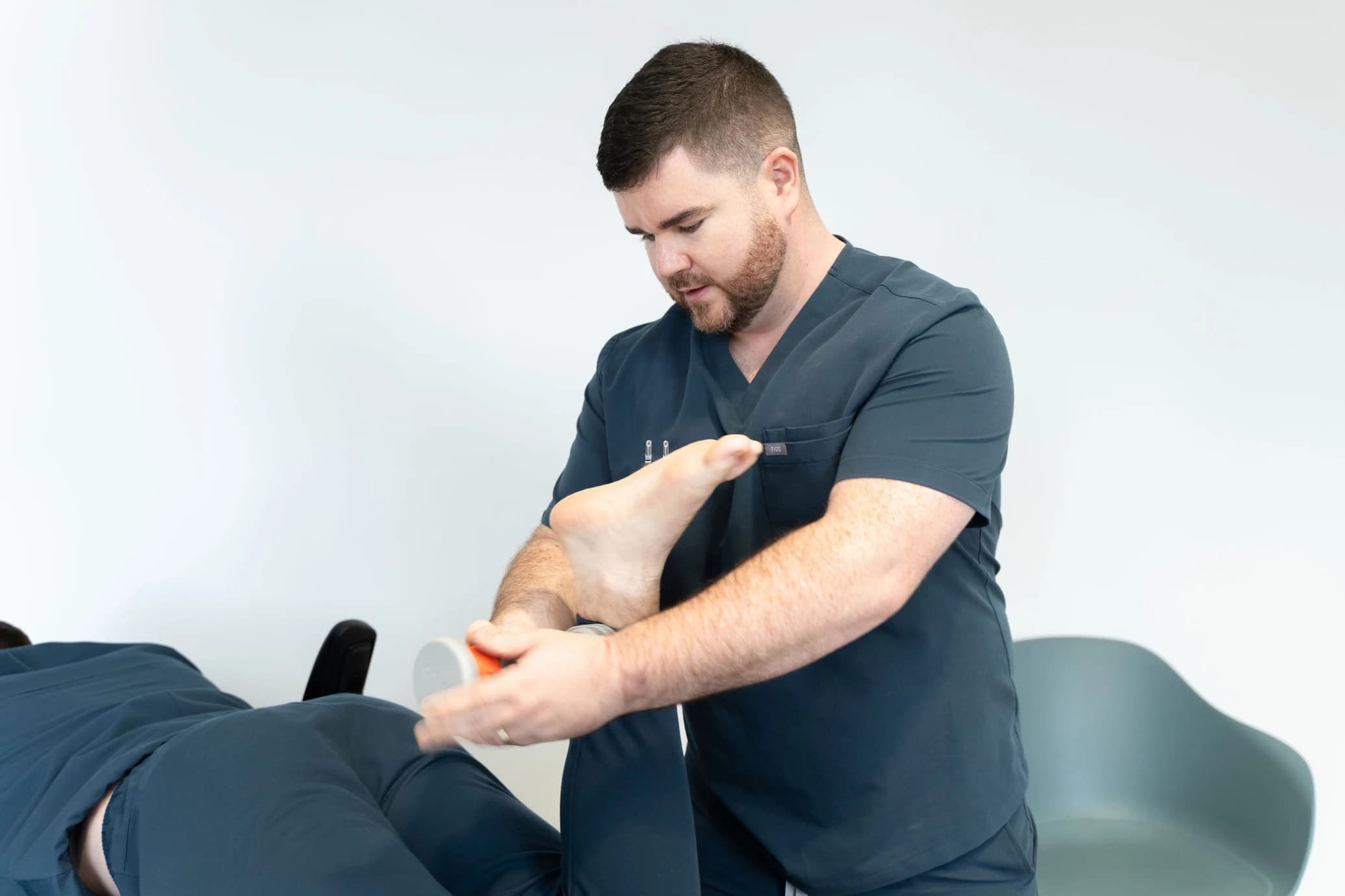
We measure the joint rather than eyeball it. Range of movement is recorded with a goniometer and compared with the other side, and the pattern of pain through the range tells us a great deal about the stage.
- Range of movement: How far the toe bends upwards and downwards, and where in that range the pain starts.
- Dorsal osteophyte: Feeling for the bony ridge on top of the joint that rubs on shoes and blocks movement.
- Sesamoid tenderness and toe strength: Checking the structures under the joint and how well the toe grips.
- Gait: Watching for the outward weight shift, early heel lift and shortened stride that hallux rigidus produces.
Diagnostic Ultrasound
Ultrasound is performed during your appointment. It shows the soft-tissue side of the problem, which X-ray cannot, and it is what we use to guide an injection if one is indicated.
- Joint effusion and synovitis: Fluid and inflammation in the joint, which tells us how active the arthritis is right now.
- Osteophytes and joint surface: The bony spurs on top of the joint and irregularity of the joint margin.
- Sesamoids and plantar structures: Ruling in or out a sesamoid problem or a plantar plate injury under the joint.
- Injection guidance: Real-time needle placement into a small joint that is often partly blocked by bone spurs.
Weight-bearing X-rays remain the standard way to grade the arthritis: joint space narrowing, the size of the dorsal spur, and changes in the sesamoids. We arrange them, or request them from your GP, when they will change the plan or when surgical referral is being considered.
Pressure Plate Gait Analysis
A stiff big toe joint changes how the whole foot loads. Pressure plate analysis shows us exactly how you are compensating and where the load has gone, which is what we design the orthotic around.
- First-ray loading: Whether the big toe is being used at push-off or avoided altogether.
- Transfer load: Overload under the second and third metatarsal heads or the outer border of the foot.
- Baseline for review: An objective record to compare against once orthotics and footwear are in place.
Treatment Options
Footwear and Rocker Soles
Custom Orthotics with Morton's Extension
Joint Mobilisation and Rehabilitation
Shockwave and Dry Needling as Adjuncts
Ultrasound-Guided Injection Where Indicated
Surgical Referral
Common Causes and Risk Factors
Joint Structure and Mechanics
Previous Injury
Footwear and Activity
Other Factors
What to Expect at Your First Appointment
Your story
5 minClinical examination
5 minDiagnostic ultrasound
10 minPressure plate analysis
5 minGrading and treatment plan
5 minRecovery and Prognosis
Hallux rigidus is progressive and conservative treatment does not reverse it, but it controls symptoms well in the majority of early to moderate cases. Footwear and orthotic changes usually make a noticeable difference within two to four weeks once the break-in period is over, and a mobilisation and exercise programme adds further improvement over four to six weeks. Just over half of all patients with hallux rigidus are managed long term without surgery, and of those managed with orthotics, around 84% do well.
In advanced disease the picture is more limited. Injections give shorter relief as the grade rises, and orthotics and rocker soles become a way of staying comfortable rather than a cure. That is the point at which surgical referral is the right conversation, and we would rather have it early and honestly than let you spend a year on treatment that is not going to work.
Your Clinicians
Paul McMullan BSc(Hons) MSc FRCPSGlasg MRCPod leads the forefoot and big toe joint service. Paul holds a Master's degree in Podiatric Sports Medicine from Queen Mary University of London and is a Fellow of the Royal College of Physicians and Surgeons of Glasgow, one of very few podiatrists in Northern Ireland with this distinction. With over 15 years of clinical experience and advanced training in diagnostic musculoskeletal ultrasound, Paul brings MSc-level expertise to every consultation.
Darren Costello BSc(Hons) MSc PGCert MRCPSGlasg HCPC MRCPod is a specialist podiatrist with a particular focus on sports podiatry, biomechanics and ultrasound imaging. Darren holds an MSc in Sports and Exercise Medicine from Ulster University and a Postgraduate Certificate in Lower Limb MSK Ultrasonography from Brunel University London.
Having two MSc-qualified clinicians trained in diagnostic ultrasound means shorter waiting times for specialist assessment and the ability to discuss complex cases collaboratively.
Why Patients Choose Lower Limb Clinic
Graded, not guessed
Diagnostic ultrasound on site
Custom orthotics from our own lab
Honest about surgery
MSc-level clinical expertise
700+ five-star Google reviews
Frequently Asked Questions
Common questions about Hallux Rigidus at Lower Limb Clinic.

Clinically reviewed by Paul McMullan, BSc(Hons) MSc FRCPSGlasg MRCPod
BSc (Hons) Podiatry · MSc Podiatric Sports Medicine (QMUL) · FRCPSGlasg · MRCPod
Lead Podiatrist & Clinical Director, Lower Limb Clinic Belfast