Quick answer
The Richie Brace is a custom, hinged ankle foot orthosis (AFO): a moulded foot orthotic joined to two lightweight uprights and a calf cuff. At Lower Limb Clinic in Belfast we fit two versions. The Dynamic Assist has spring hinges that lift the foot by up to 15 degrees as you step, for foot drop. The standard (fixed) Richie Brace controls the rolling-in and arch collapse of adult acquired flat foot, also called posterior tibial tendon dysfunction (PTTD). Both are made from a 3D scan of your foot and leg, fit inside most lace-up shoes, and still let the ankle bend.
What is an AFO?
An ankle foot orthosis, or AFO, is any brace that spans the foot and ankle to control how they move. Traditional AFOs are rigid plastic shells that run up the back of the calf. They work, but they are bulky, need oversized shoes and block the ankle, so many people stop wearing them.
The Richie Brace was designed to fix that. It is shorter, lighter and hinged at the ankle, so the ankle can still bend up and down when you walk while the brace controls the unwanted movement: either the foot dropping, or the heel and arch collapsing inwards.
Use case 1: foot drop
What foot drop is
Foot drop is weakness of the muscles that lift the front of the foot (the ankle dorsiflexors, mainly tibialis anterior). When you swing the leg forward, the toes do not clear the ground. People describe catching their toes on kerbs and carpets, tripping, a slapping sound as the foot lands, or lifting the knee high to compensate.
Common causes
- Common peroneal nerve injury at the outside of the knee (after a knee injury, surgery, prolonged leg crossing or a tight cast)
- L5 nerve root compression from the lower back (sciatica with weakness)
- Stroke
- Multiple sclerosis
- Charcot-Marie-Tooth disease and other peripheral neuropathies
New foot drop always needs its cause investigated. If it appeared suddenly, or with back pain and numbness, see your GP or an urgent care service first. A brace manages the walking problem; it does not replace finding out why the nerve or muscle has stopped working.
How the Dynamic Assist helps
The Richie Brace Dynamic Assist uses two sprung hinges, one either side of the ankle. As your foot leaves the ground, the springs lift the front of the foot by up to 15 degrees so the toes clear the floor. When the heel lands, the ankle can still move naturally. Because it is hinged rather than a fixed block, it gives a smoother, more normal step than a rigid drop-foot splint, and it fits in a normal shoe.
NICE's guidance on stroke rehabilitation recommends considering an ankle foot orthosis for people with drop foot after stroke, to improve walking. The same mechanical principle applies whatever the cause: a foot that clears the ground is a foot that trips less.
When the Dynamic Assist is not the right brace
- Strong calf spasticity or clonus (common after some strokes): a spring is not strong enough to overcome it, and a more rigid AFO is usually better.
- A fixed, stiff ankle that cannot be brought up to neutral by hand.
- Significant swelling that changes day to day, which makes a close custom fit hard to maintain.
- Reduced sensation with skin breakdown risk (for example advanced diabetic neuropathy), where every brace needs very careful fitting and skin checks.
If one of these applies, we will tell you at assessment and suggest the right alternative or referral.
Use case 2: severe adult acquired flat foot (PTTD)
What adult acquired flat foot is
The posterior tibial tendon runs behind the inside ankle bone and is the main dynamic support of the arch. When it is overloaded and starts to fail, the heel rolls outwards, the arch flattens, the forefoot swings out and the foot slowly collapses. It is most common in people over 40, and more so with higher body weight, diabetes, high blood pressure or previous foot injury. The current medical term is progressive collapsing foot deformity.
Typical signs are pain and swelling along the inside of the ankle, a foot that looks flatter than the other one, the "too many toes" sign (from behind, you can see more toes on the outside of the affected foot), and difficulty standing up on tiptoe on that one leg.
Why staging matters
Adult acquired flat foot is graded by how far it has progressed and whether the foot is still flexible:
- Early (tendon pain, shape unchanged): custom foot orthoses and a structured loading programme are usually enough.
- Flexible deformity (arch collapsing but correctable by hand): this is where a custom AFO such as the Richie Brace earns its place, because a foot orthotic alone often cannot control the hindfoot.
- Rigid deformity: a brace is used to support and relieve pain, not correct, and a surgical opinion is usually discussed.
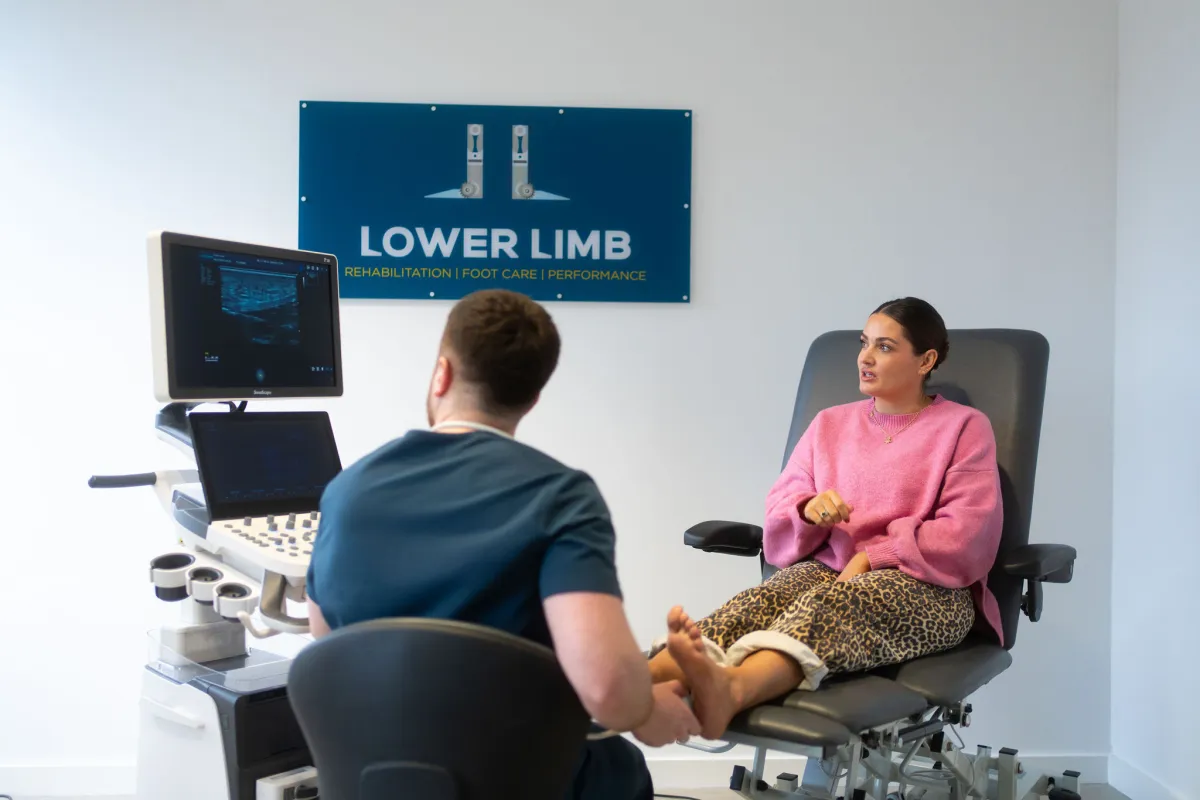
At Lower Limb we scan the posterior tibial tendon with diagnostic ultrasound and assess your gait before recommending a brace, so the recommendation matches the stage you are actually at.
How the standard Richie Brace helps
The fixed Richie Brace holds the heel and arch in a better position, takes strain off the tendon and limits the rolling-in that drives the deformity, while the ankle hinge still lets you walk normally. In practice, it is the support that lets the tendon settle while you rebuild strength.
What the evidence says
In a study by Alvarez and colleagues (Foot & Ankle International, 2006), 47 patients with early and flexible posterior tibial tendon dysfunction were treated with an orthosis (including a short articulated AFO) plus a daily strengthening programme. 83% had a successful outcome at a median of four months, and only a small minority went on to need surgery. A randomised trial by Kulig and colleagues (Physical Therapy, 2009) found that orthoses combined with progressive resistance exercise reduced pain and improved function in early PTTD. The message from both: a brace works best with exercise, not instead of it.
Other uses
We also use custom AFOs, including the Richie Brace, for ankle arthritis, long-term ankle instability that has not settled with rehab, and some neuromuscular conditions where the foot and ankle need controlled support. These are judged case by case.
Richie Brace vs a standard foot orthotic
- Foot orthotic: sits under the foot only. Good for early tendon problems, heel pain and mild flat feet.
- Richie Brace: foot orthotic plus ankle uprights. Needed when the problem is above the foot as well as under it: a heel that keeps rolling in despite an orthotic, or a foot that will not lift.
If you have tried good custom orthotics and the foot is still collapsing, that is often the point to consider a brace. Our guide to whether custom orthotics are worth it covers the orthotic side.
How we fit a Richie Brace in Belfast
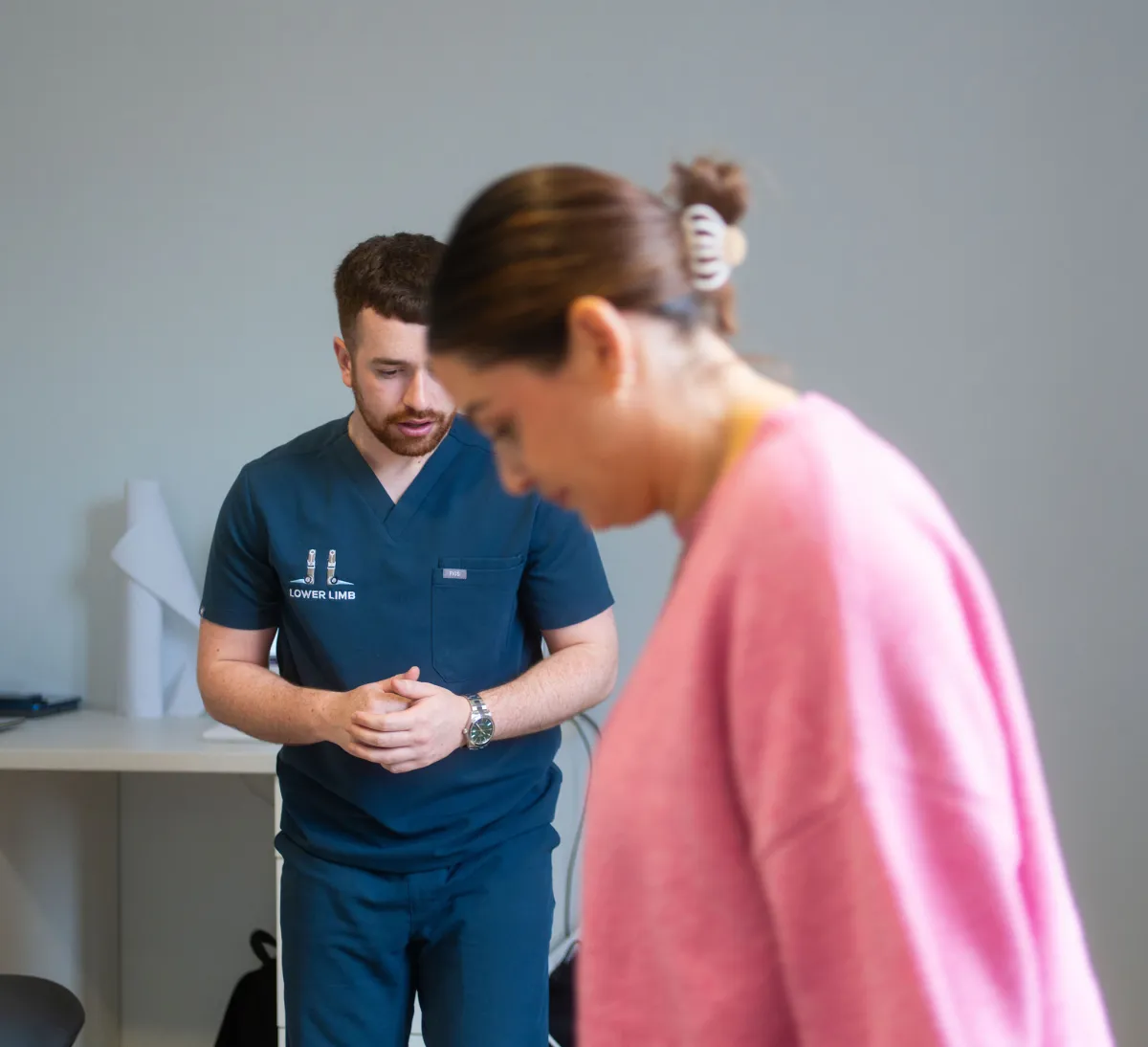
- Assessment: history, gait analysis, strength and range of motion testing, and ultrasound of the posterior tibial tendon where flat foot is the issue.
- 3D scan: a digital scan of your foot and lower leg. No plaster.
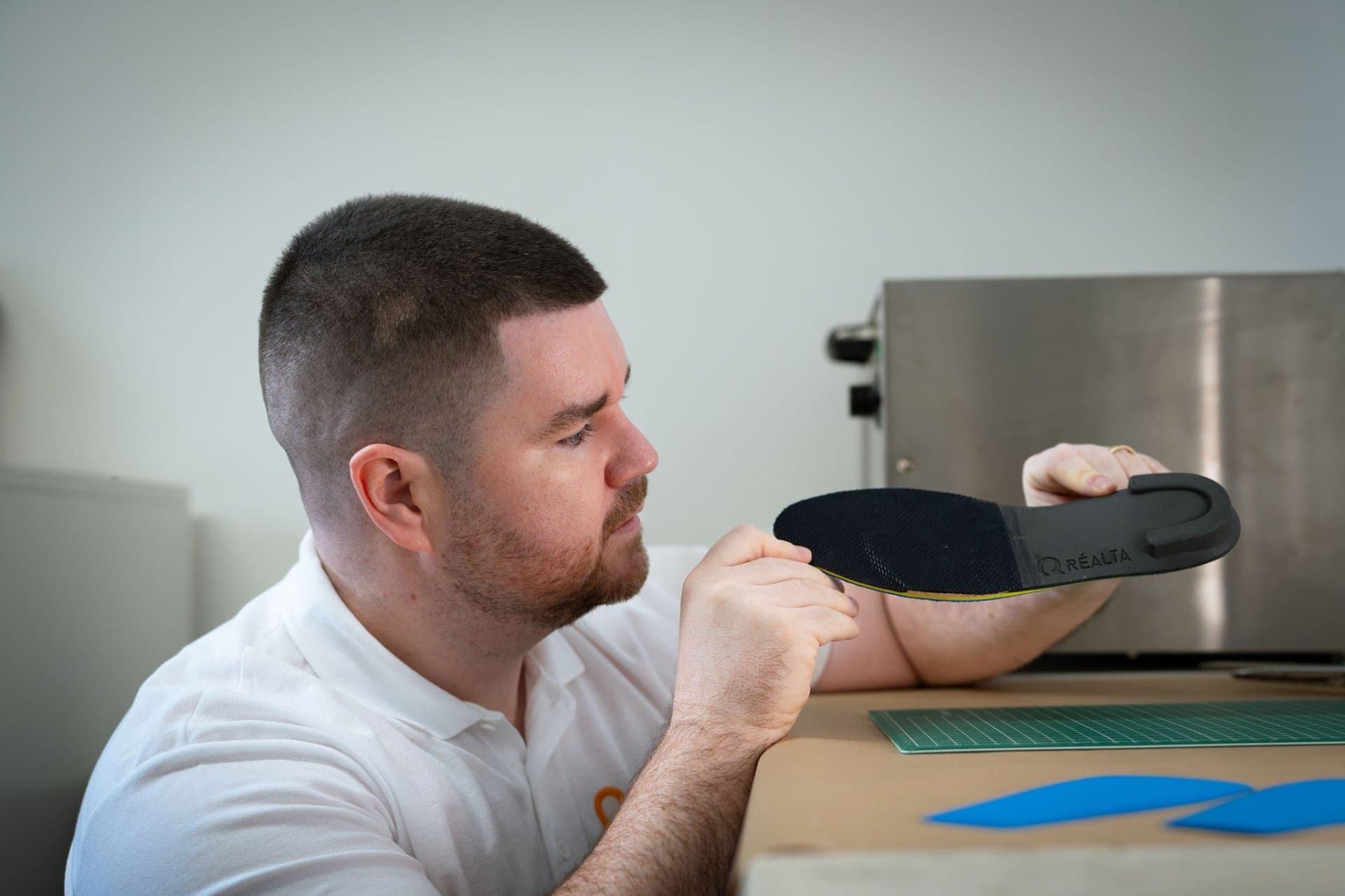
- Manufacture: the brace is built to your prescription, fixed or Dynamic Assist.
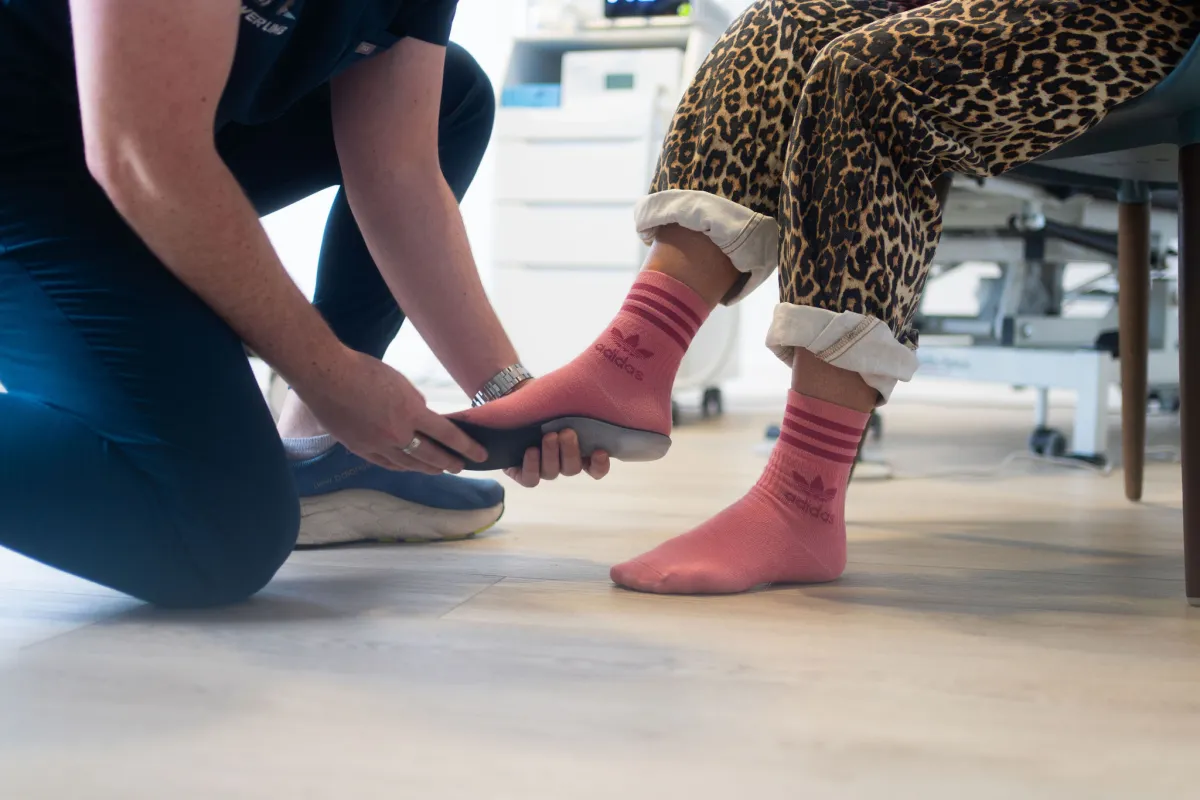
- Fitting: we fit it in your own shoes and adjust it so it controls the foot without rubbing.
- Review: a follow-up once you have worn it in, plus your exercise programme.
Full service details are on our Richie Brace and custom AFO page. You can also read about posterior tibial tendon problems and flat feet.
Frequently asked questions
What is a Richie Brace?
The Richie Brace is a custom, hinged ankle foot orthosis (AFO). It combines a moulded foot orthotic with two lightweight uprights and a padded calf cuff, hinged at the ankle. It controls the foot and ankle while still letting the ankle bend when you walk.
Is a Richie Brace good for foot drop?
Yes, for flexible foot drop without strong calf spasticity. The Dynamic Assist version has spring hinges that lift the front of the foot by up to 15 degrees as you step, so the toes clear the ground. If there is strong spasticity or a stiff ankle, a more rigid AFO is usually better.
Can a brace help adult acquired flat foot without surgery?
Often, yes, in the early and flexible stages. Research shows that an orthosis combined with a strengthening programme gives a successful outcome for most patients with early posterior tibial tendon dysfunction (83% in Alvarez et al., 2006). Rigid, advanced cases usually need a surgical opinion, and the brace is then used for support and pain relief.
Will a Richie Brace fit in my shoes?
Most lace-up shoes and trainers with a removable insole will take it. Some people go up half a size. Slip-on shoes, court shoes and sandals generally will not work.
Is it bulky?
No. It is much lower-profile and lighter than a traditional rigid AFO, sits inside the shoe, and the ankle still moves.
Is the Richie Brace off the shelf?
No. At Lower Limb Clinic each Richie Brace is made to order from a 3D scan of your foot and lower leg, to a prescription based on your assessment.
Do I wear it all day?
Mainly when you are on your feet and walking. We build your wear time up gradually over the first couple of weeks so your skin and muscles adapt.
Do I need a GP referral?
No. You can book an assessment directly at our Lisburn Road or Ormeau Road clinics in Belfast. If your foot drop is new or unexplained, we will advise you on getting the cause investigated as well.
Foot catching, or an arch that is collapsing?
Book an assessment at Lower Limb Clinic or call 028 9013 9185. Lisburn Road and Ormeau Road, Belfast. No GP referral needed. Many brace patients travel to us from across Northern Ireland, the rest of the UK and Ireland.
About the Author
Paul McMullan BSc(Hons) MSc FRCPSGlasg MRCPod is the founder and lead clinician at Lower Limb Clinic, Belfast. He holds an MSc in Podiatric Sports Medicine from Queen Mary University of London and is a Fellow of the Royal College of Physicians and Surgeons of Glasgow, with advanced training in diagnostic musculoskeletal ultrasound.
References: Alvarez RG et al. Stage I and II posterior tibial tendon dysfunction treated by a structured nonoperative management protocol: an orthosis and exercise program. Foot Ankle Int. 2006;27(1):2-8. Kulig K et al. Nonsurgical management of posterior tibial tendon dysfunction with orthoses and resistive exercise: a randomized controlled trial. Phys Ther. 2009;89(1):26-37. NICE guideline NG236, Stroke rehabilitation in adults (2023).
Disclaimer: This article is general information, not medical advice. If you have new weakness in your foot or leg, seek medical assessment promptly.