





What is a Richie Brace?
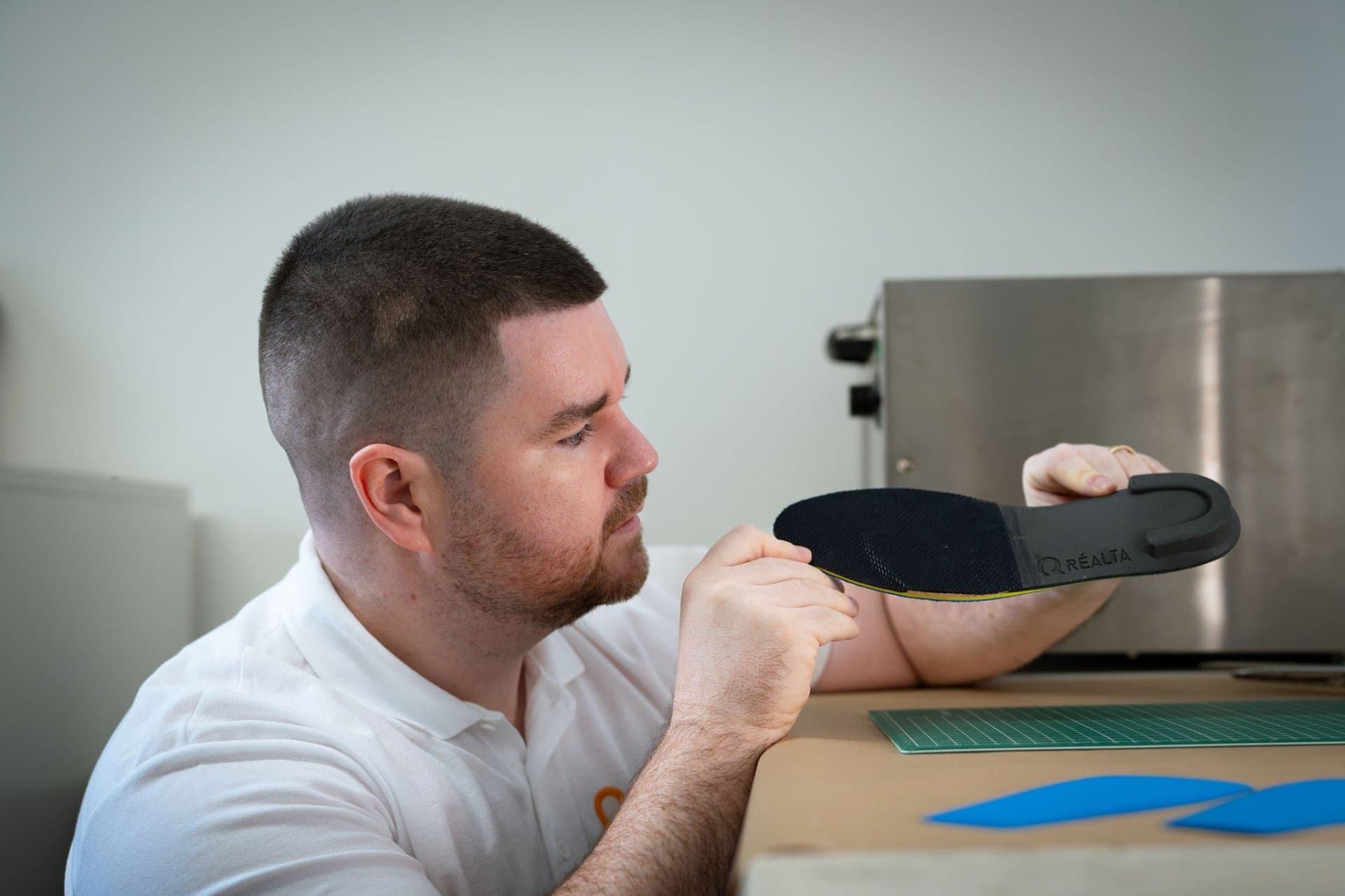
An ankle foot orthosis (AFO) is a custom device that controls the position and movement of the foot and ankle. The Richie Brace is the most refined version in common use: a moulded foot orthotic with two semi-rigid uprights and a padded calf cuff, hinged at the ankle, and built from a precise 3D scan of your own leg and foot rather than a messy plaster cast.
Because it is articulated rather than a rigid block, it supports and controls the joint while still allowing a natural walking pattern. It is also far lower-profile than a traditional AFO, so it fits inside many normal shoes. That combination of control and comfort is why patients wear it, and compliance is everything with a brace.
We fit two configurations: a fixed, motion-controlling brace for adult acquired flat foot, and a spring-assist brace for drop foot. Which one is right depends entirely on your diagnosis, which is why the assessment comes first.
The Two Braces We Fit
Fixed Richie Brace, for adult acquired flat foot
Set to control and limit the motion that drives the deformity, this brace supports the collapsing hindfoot and arch and offloads the posterior tibial tendon. By holding the foot in a corrected position, it relieves pain, helps halt progression, and in suitable cases can avoid or delay surgery.
Spring-Assist Richie Brace, for drop foot
Sprung Tamarack ankle hinges provide up to 15 degrees of dorsiflexion assist, lifting the foot through the swing phase of your step so the toes clear the ground instead of catching and tripping you. It restores a safer, smoother gait while still allowing natural ankle movement and controlling side-to-side instability, and it is far more dynamic and discreet than a rigid drop-foot splint.
Conditions We Treat
Adult Acquired Flat Foot (PTTD)
A progressive flattening of the arch caused by failure of the posterior tibial tendon, the main support of the arch. Left unmanaged it tends to worsen and become rigid. A fixed Richie Brace supports the tendon and arch and controls the deformity, often avoiding the need for surgery in flexible stages.
Drop Foot
Difficulty lifting the front of the foot, causing toe drag, trips, and a high-stepping gait. Causes include stroke, multiple sclerosis, peripheral nerve injury, L5 nerve-root problems, and Charcot-Marie-Tooth disease. The spring-assist brace restores swing-phase clearance while the underlying cause is managed.
Related conditions
We also use custom AFOs for ankle osteoarthritis, chronic ankle instability, and selected neuromuscular conditions where the foot and ankle need controlled support.
Why a Custom Richie Brace, Not an Off-the-Shelf AFO
What to Expect
Thorough assessment
3D scan
Custom manufacture
Fitting & adjustment
Review
Why Patients Travel to Us
Custom AFO and Richie Brace fitting is a niche service, and few clinics wrap it in a proper diagnostic assessment. We stage your condition with diagnostic ultrasound and gait analysis, prescribe the right brace for your exact anatomy, and back it with in-house orthotic expertise. That is why patients travel to us from across Northern Ireland, the rest of the UK, and Ireland for this.
Your Clinicians
Paul McMullan BSc(Hons) MSc FRCPSGlasg MRCPod holds a Master's degree in Podiatric Sports Medicine from Queen Mary University of London and is a Fellow of the Royal College of Physicians and Surgeons of Glasgow, with advanced training in diagnostic musculoskeletal ultrasound and biomechanics.
Darren Costello BSc(Hons) MSc PGCert MRCPSGlasg HCPC MRCPod holds an MSc in Sports and Exercise Medicine from Ulster University and holds a Postgraduate Certificate in Lower Limb MSK Ultrasonography from Brunel University London, with a particular focus on biomechanics and gait.
Frequently Asked Questions
Common questions about Richie Brace & Custom AFO at Lower Limb Clinic.
Clinically reviewed by Paul McMullan, BSc(Hons) MSc FRCPSGlasg MRCPod
BSc (Hons) Podiatry · MSc Podiatric Sports Medicine (QMUL) · FRCPSGlasg · MRCPod
Lead Podiatrist & Clinical Director, Lower Limb Clinic Belfast