"Should I see a chiropodist or a podiatrist?" is probably the single most common question we field at Lower Limb Clinic. It comes up in the waiting room, on the phone, in online reviews. People want to know whether they're booking the right kind of appointment, and whether the term on our website matches the service they actually need.
The short answer: chiropodist and podiatrist are the same profession with the same qualifications. There is no difference in training, registration, or scope of practice. One word is the traditional British term; the other is the modern international term.
That's the headline. But it's worth understanding the detail, because the terminology does say something about how the profession has evolved, and about what kind of service you can reasonably expect when you book an appointment.
The Same Profession, Two Words
In the UK, chiropody and podiatry refer to the same regulated profession. Every clinician using either title must be registered with the Health and Care Professions Council (HCPC), the statutory regulator for podiatrists in the UK. The training pathway is identical: a three-year BSc (Hons) in Podiatry, followed by HCPC registration and, for many clinicians, further postgraduate study.
The title "chiropodist" has Greek roots (cheir meaning hand, pous/podos meaning foot) and was the dominant term in Britain from the 19th century onwards. "Podiatrist" came from North America, where the profession rebranded around a term that emphasised foot, not hand. In 1993, the British professional body rebranded from the "Society of Chiropodists" to the "Society of Chiropodists and Podiatrists", and today operates as the Royal College of Podiatry.
Legally, a UK-registered foot health specialist can use either title. Many clinicians, and many clinics, use both, reflecting patient familiarity with each term.
Why You'll See "Podiatrist" More Often Now
The shift toward "podiatrist" is partly branding, but it also reflects a genuine expansion of the profession's scope over the last 30 years.
Traditional chiropody was primarily associated with skin and nail care: corns, calluses, hard skin, toenail cutting, fungal nails, cracked heels. This is still a huge part of what we do. It's essential work, it keeps people mobile, and for many patients, particularly older adults and people with diabetes, it's the single most valuable regular healthcare appointment they'll make.
But modern podiatry has grown well beyond routine foot care. It now routinely includes:
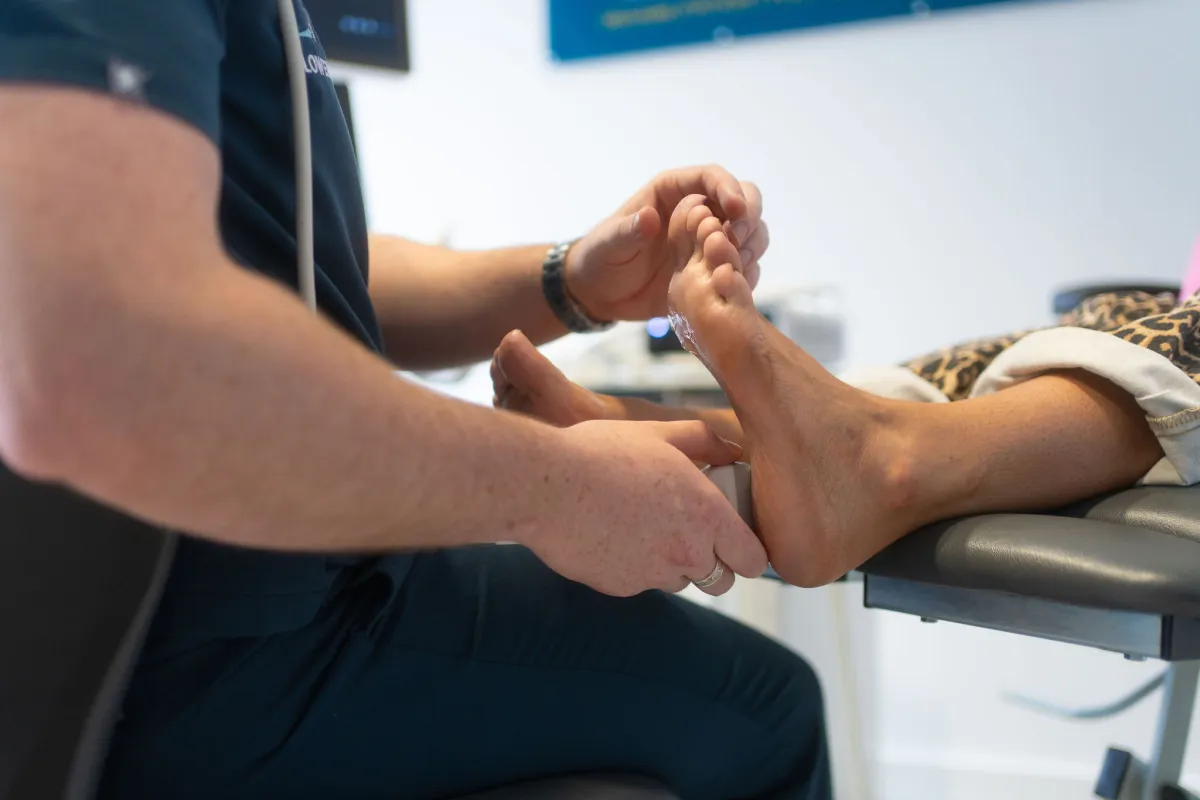
- Musculoskeletal (MSK) assessment and treatment: diagnosis and management of foot, ankle and lower limb pain using clinical examination, diagnostic ultrasound, and biomechanical gait analysis
- Sports medicine: running injury management, tendinopathy rehabilitation, return-to-sport programming, and working with athletes and active patients of all levels
- Advanced therapies: shockwave therapy, ultrasound-guided injection therapy, custom 3D-printed orthotics
- Minor surgery: partial or total nail avulsion under local anaesthetic, typically for ingrown toenails
- Diabetic and high-risk foot care: screening, risk stratification, and management to prevent complications like ulceration and amputation
A modern podiatry clinic is, in other words, a musculoskeletal and foot health centre, not just a nail-cutting service. That broader scope is why "podiatrist" has become the preferred term in professional and academic settings.
So What Should You Actually Book?
For practical purposes, here's how to think about it:
Book a chiropody appointment if you need…
- Routine foot and nail care: toenail cutting, callus reduction, corn removal, hard skin treatment
- Help with problem nails: thickened, discoloured, painful, or fungal nails
- An ingrown toenail that hasn't responded to home care
- Cracked heel treatment, fissure care, or help managing dry, painful feet
- A diabetic foot assessment or regular foot health check if you have diabetes, peripheral neuropathy, or vascular disease
- A verruca that over-the-counter treatments haven't cleared
Book a podiatry / MSK appointment if you need…
- Diagnosis and treatment for foot, ankle, knee or lower limb pain. Our pain & injury assessment includes diagnostic ultrasound where clinically indicated
- Help with a specific condition: plantar fasciitis, Achilles tendinopathy, shin splints, Morton's neuroma, stress fractures, runner's knee
- Custom orthotic therapy after biomechanical assessment
- Sports injury rehab or return-to-running programming
- Shockwave therapy or ultrasound-guided injection therapy for chronic pain
If you're unsure, that's fine too. Just book a general appointment or call us. We'd rather have a 30-second conversation to get you into the right appointment than watch you pick the wrong one.
How to Choose a Good One
Because chiropody and podiatry are the same profession, the title on the door isn't the thing that differentiates good from poor care. The things that actually matter are:
1. HCPC registration
This is non-negotiable. If a clinician isn't HCPC-registered, they're not legally allowed to call themselves a chiropodist or podiatrist in the UK. You can check the HCPC register for any practitioner's name in seconds. At Lower Limb Clinic, every clinician is HCPC-registered. We list our registration numbers openly on our BUPA and WPA pages.
2. Professional body membership
Membership of the Royal College of Podiatry signals ongoing CPD commitment and access to peer-reviewed clinical guidance. Fellowship of the Royal College of Physicians and Surgeons of Glasgow (FRCPSGlasg) or Membership (MRCPSGlasg) is an additional marker of advanced clinical practice, often held by those with substantial MSK or surgical experience.
3. Postgraduate qualifications
BSc-level training is the foundation. But for complex MSK, sports medicine, or diagnostic work, look for MSc-qualified clinicians. An MSc in Podiatric Sports Medicine, MSc in Sports and Exercise Medicine, or a PGCert in MSK ultrasound represents a meaningful step beyond baseline training.
4. Health insurance recognition
Being recognised by major UK health insurers, particularly BUPA and WPA, is a quiet but significant quality signal. Insurers carry out credentialling before listing providers, and the process flushes out clinicians who don't meet minimum standards of training and documentation. Recognition also means that if you have private health insurance, you may be able to claim for your treatment.
5. In-clinic diagnostic capability
For any MSK problem, the clinic's diagnostic toolkit matters. In-house musculoskeletal ultrasound, pressure-plate gait analysis, and VALD force-plate and muscle dynamometry testing mean decisions are grounded in real data rather than best-guess diagnoses.
Our Model at Lower Limb Clinic
We deliberately present ourselves as a chiropody, podiatry and sports medicine clinic, not one or the other. That's because we think the traditional chiropody/podiatry split is unhelpful for patients. A good foot care service needs to do both: the routine skin-and-nail care that keeps people mobile, and the more specialist MSK and sports medicine work that resolves pain and prevents long-term problems.
Our two Belfast clinics on Lisburn Road and Ormeau Road are set up to do that under one roof:
- Chiropody appointments: corns, calluses, nail care, fungal nails, diabetic foot checks
- Specialist MSK assessments, with diagnostic ultrasound and biomechanical analysis
- Custom 3D-printed orthotics, designed and manufactured in-house
- Shockwave therapy and ultrasound-guided injection therapy, BUPA and WPA recognised
- Nail surgery under local anaesthetic
- Swift microwave therapy and other advanced verruca treatments
- Specialist physiotherapy: lower limb and upper limb rehab, backed by VALD objective testing
Every clinician is HCPC-registered. We're BUPA and WPA recognised. We have 700+ five-star Google reviews. And no matter what you call the service (chiropody, podiatry, foot care, MSK) you'll be seen by the same team, in the same clinics, with the same clinical standards.
Not sure which appointment is right for you?
Give us a call on 028 9013 9185 and we'll help you choose, or book online. BUPA and WPA patients welcome, no GP referral needed.
Quick FAQ
Do chiropodists and podiatrists have the same training?
Yes. Identical. Both complete a three-year BSc (Hons) in Podiatry and must register with the HCPC to practise in the UK.
Is a podiatrist better qualified than a chiropodist?
No. They have the same qualification. Any difference between two specific clinicians comes down to their individual postgraduate training and experience, not whether they call themselves a chiropodist or podiatrist.
Can a chiropodist treat sports injuries?
Yes, provided they have the training and equipment to do so. Sports medicine is now firmly within podiatric scope. Look for MSc-qualified clinicians, in-house diagnostic ultrasound, and MSK-focused experience.
Do I need a GP referral?
No. You can book directly with a UK chiropodist or podiatrist without a GP referral. If you have private health insurance, pre-authorisation is usually required by the insurer, and we help with this as part of the booking process.
Is a chiropodist the same as a foot doctor?
Essentially yes, in common use. "Foot doctor" is an informal term that most people use to mean a chiropodist or podiatrist. In the UK, only registered podiatrists can use the title formally.
Are chiropody treatments covered by BUPA or WPA?
Routine chiropody (nail care, callus) typically isn't covered by most UK health insurance policies, which focus on MSK treatment. But our MSK services (pain and injury assessments, shockwave therapy, injection therapy, and our upcoming physiotherapy service) are BUPA and WPA recognised.
About the Author
Paul McMullan BSc(Hons) MSc FRCPSGlasg MRCPod is the founder and lead clinician at Lower Limb Clinic, Belfast. He holds an MSc in Podiatric Sports Medicine from Queen Mary University of London and is a Fellow of the Royal College of Physicians and Surgeons of Glasgow. He is HCPC-registered and recognised by BUPA and WPA for MSK services. The clinic operates from two Belfast locations: 385 Lisburn Road and 373 Ormeau Road.
Disclaimer: This article is intended for general informational purposes only and does not constitute medical advice. If you have a specific foot, ankle or lower limb concern, please book an assessment with a qualified HCPC-registered chiropodist or podiatrist.