If you've ever had an ingrown toenail, you know how disproportionately painful such a small problem can be. At Lower Limb Clinic in Belfast, we treat ingrown toenails every single day, from early-stage discomfort that responds to conservative care, to severely infected nails requiring surgical correction. In this guide, we explain everything you need to know: what causes them, how to recognise when it's serious, what your treatment options are, what to expect from nail surgery (ingrown toenail removal in Belfast is £365 all-inclusive, or a £58 assessment first, deducted if you go ahead), and how to stop them coming back.
Quick Summary
Ingrown toenails are one of the most common conditions we treat. Conservative care resolves mild cases in one visit. For recurrent or infected nails, nail surgery (Partial Nail Avulsion) is a 30-minute procedure with a 98% success rate. Most patients return to work the next day. No GP referral needed. Book online or call 028 9013 9185.
What Causes Ingrown Toenails?
Ingrown toenails, medically known as onychocryptosis, occur when the edge or corner of the toenail curves downward and grows into the surrounding skin rather than over it. The big toe is most commonly affected, though any toe can develop the problem. In many cases, more than one of the factors below combine to produce the issue. For example, a person with naturally curved nails who also wears tight footwear is at particularly high risk.
The most frequent causes we see at our Belfast clinics include:
- Incorrect nail cutting: Cutting nails too short or rounding the corners encourages the nail edge to dig into the skin as it grows. Nails should always be cut straight across.
- Tight or ill-fitting footwear: Shoes that compress the toes, particularly narrow or pointed styles, press the nail into the surrounding tissue.
- Trauma: Stubbing your toe, dropping something heavy on it, or repeated impact during sport can damage the nail and alter its growth pattern.
- Genetics: Some people have naturally curved or involuted (pincer) nails that are inherently more likely to ingrow, regardless of footwear or cutting technique.
- Excessive sweating: Sweaty feet soften the skin around the nail fold, making it easier for the nail edge to penetrate.
- Sports activity: Repeated kicking, running in tight boots, or activities that cause repeated toe trauma (GAA football, rugby, running) are common triggers we see in Belfast patients.
- Thickened nails: As we age, nails can thicken and become more difficult to cut correctly, increasing the risk.
How Serious Is Yours? Recognising the Three Stages
Not all ingrown toenails are equal. Understanding which stage you're at helps determine whether home care is appropriate or whether you need to be seen urgently.
| Stage | Symptoms | Recommended Treatment |
|---|---|---|
| Stage 1: Mild | Tender, slightly swollen skin alongside the nail. Redness. Pain on pressure. No pus or discharge. | Conservative “quick fix”. We numb the toe with local anaesthetic and remove the offending nail edge painlessly in a single visit. Instant relief, no surgery required. |
| Stage 2: Developing infection | Increased swelling. Skin warm to touch. Watery or cloudy fluid. Walking in shoes is uncomfortable. | Nail surgery generally recommended. See a podiatrist promptly. Do not attempt to cut the nail yourself. |
| Stage 3: Established infection | Pus visible. Significant swelling and pain at rest. Red, inflamed overgrowth of tissue (hypergranulation). Nail partially buried. | Nail surgery recommended. May also need antibiotics. Seek urgent professional treatment. |
When to seek urgent help
If you have diabetes, poor circulation, or a compromised immune system, do not attempt home treatment for any stage of ingrown toenail. Infections can escalate rapidly. Call us directly on 028 9013 9185.
Should You Treat It at Home or See a Podiatrist?
Try home care if, and only if, the nail is at Stage 1 with no signs of infection:
- Soak the foot in warm salt water for 15-20 minutes, three to four times per day
- Wear open-toed sandals or wide-fitting shoes to relieve pressure
- Take paracetamol or ibuprofen for pain
- Allow the nail to grow out. Do not attempt to cut the corner off
See a podiatrist immediately if any of the following apply:
- Pus or discharge is visible at the nail edge
- You have diabetes, poor circulation, or a compromised immune system
- The pain is stopping you from walking normally
- The skin has started to overgrow the nail (hypergranulation tissue)
- Home care has shown no improvement after 5-7 days
- You have a fever, feel hot or shivery, or notice red streaking from the toe
NHS waiting times in Northern Ireland
NHS podiatry referrals are often several months. You can self-refer directly to a private podiatrist without seeing a GP first. At Lower Limb Clinic we offer same-week appointments at both our Lisburn Road and Ormeau Road clinics.
Treatment Option 1: Conservative Care (The “Quick Fix”)
For Stage 1 ingrown toenails (mild, not yet infected) conservative treatment offers fast relief in a single visit. We call this the “quick fix” because that is exactly what it is: you walk in with a painful toe and walk out comfortable.
How the quick fix works
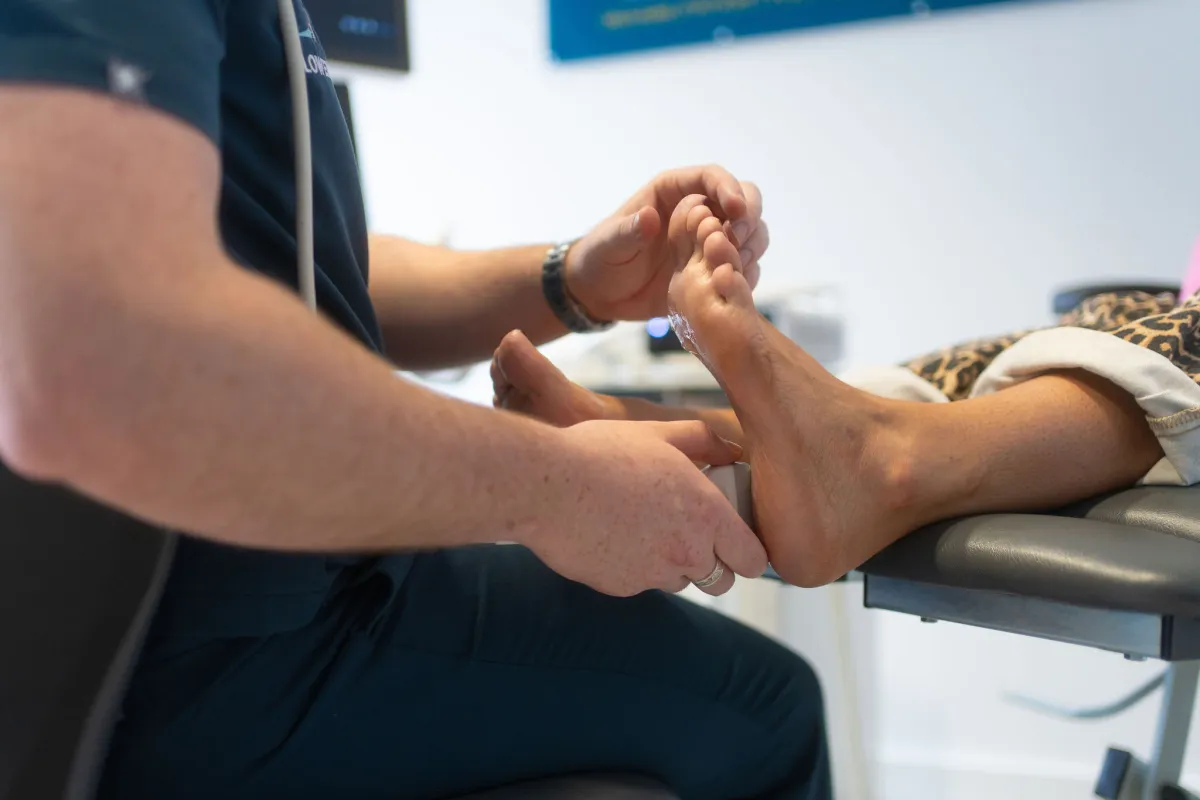
We apply a local anaesthetic to numb the toe completely, then carefully remove the offending nail edge or spike using precision instruments. Because the toe is fully numb, the procedure is completely painless, even for patients who have been dreading the appointment. The whole visit takes 15-20 minutes and most patients leave feeling immediate, significant relief.
A typical conservative visit includes:
- Local anaesthetic: The toe is numbed so the nail edge can be removed without any pain
- Professional nail cutting: The offending nail spike or edge is removed with precision instruments
- Nail packing: A small wisp of material is placed under the nail edge to redirect growth away from the skin and allow healing
- Antiseptic dressing: Applied if there is any early inflammation or skin breakdown
- Nail cutting and footwear advice: To prevent recurrence
The limitation of conservative care is that it is not a permanent solution. It does not address the underlying nail shape or growth pattern, so recurrence is possible, particularly in people with naturally curved or involuted nails. If you find the same toe keeps coming back, nail surgery is worth considering as a permanent fix.
For Stage 2 and Stage 3 ingrown toenails, where infection has developed or the problem keeps returning, we generally recommend proceeding straight to nail surgery rather than repeating conservative treatment.
Treatment Option 2: Nail Surgery (Partial Nail Avulsion)
Nail surgery is the gold standard treatment for recurrent or infected ingrown toenails, and the procedure we most commonly perform at Lower Limb Clinic. Here is exactly what is involved:
Step 1: Local Anaesthetic
Before anything begins, the toe is numbed completely with a local anaesthetic injection at the base of the toe (a digital nerve block). This injection is the only uncomfortable moment in the entire procedure and typically lasts around 10 seconds. Once numb, you will feel pressure but no pain at all. The anaesthetic takes effect within a few minutes and the podiatrist will check that the toe is fully numb before proceeding.
Step 2: Nail Edge Removal (Partial Nail Avulsion)
Only the problematic edge (or edges, if both sides are affected) of the nail is removed. This is not a total nail removal. The rest of the nail remains intact and looks completely normal.
Step 3: Phenolisation
This is the step that makes the difference between a temporary fix and a permanent solution. After the nail edge is removed, phenol, a chemical agent, is applied to the nail matrix (the growth tissue at the base of the nail). This destroys the cells responsible for growing that section of nail, preventing it from returning.
The result: the treated section of nail does not regrow. The remaining nail looks normal within a few weeks as the phenol-treated area heals. The NHS confirms partial nail removal with phenolisation is 98% effective at preventing recurrence.
Step 4: Dressing and Discharge
The toe is dressed and you walk out of the clinic. There is no hospital stay, no general anaesthetic, and no need for anyone to drive you (unless surgery is on your right foot). The entire procedure from preparation to discharge takes approximately 30-45 minutes.
You can read more about the full nail surgery process on our dedicated nail surgery Belfast page.
Your Nail Surgery Team
Nail surgery at Lower Limb Clinic is performed by three HCPC-registered podiatrists:

Darren Costello
BSc (Hons) Podiatry · MSc Sports & Exercise Medicine · HCPC Registered
@darrencostello_sportspodiatryCovered by BUPA?
Paul McMullan and Bronagh Martin are registered BUPA providers. Nail surgery may be covered under your BUPA policy. Visit our BUPA insurance page for procedure codes, pre-authorisation steps, and how to claim.
Quick fix vs. nail surgery at a glance
| Quick Fix (Conservative) | Nail Surgery (PNA) | |
|---|---|---|
| Duration | 15-20 minutes | 30-45 minutes |
| Pain | None (local anaesthetic) | None (local anaesthetic) |
| Permanent? | No, recurrence possible | Yes, 98% permanent |
| Best for | Stage 1: mild, first-time | Stage 2/3: recurrent or infected |
| Recovery | Immediate | Back to work next day |
Ready to get it sorted?
Same-week appointments · No GP referral · Lisburn Road & Ormeau Road
What to Expect After Nail Surgery: Recovery & Aftercare
Recovery from ingrown toenail surgery is straightforward for the vast majority of patients. Here is what to expect:
In the First 24-48 Hours
The local anaesthetic will wear off 2-4 hours after the procedure. As it does, you may experience some throbbing or aching. This is normal. Paracetamol or ibuprofen is sufficient for pain relief. Keep the toe elevated where possible that evening.
Dressing and Wound Care
Keep the dressing dry for the first 24-48 hours. You will have a follow-up dressing change appointment at the clinic shortly after surgery, typically within 2-3 days. From then, daily salt water soaks begin. These promote clean healing and reduce infection risk. Use a tablespoon of table salt in a bowl of warm water and soak the toe for 5-10 minutes, then pat dry gently and apply a clean dressing. The clinic provides full written aftercare instructions and all the dressings you need for the first week.
Returning to Normal Activity
| Activity | Timeline |
|---|---|
| Desk work / light activity | Most patients return the following day |
| Active work / standing all day | 3-5 days |
| Open-toed or wide-fitting shoes | Wear for the first 1-2 weeks |
| Swimming | Avoid for 2-3 weeks |
| Strenuous sport | Avoid for 2-3 weeks |
| Full healing | 4-6 weeks (comfortable well before this) |
What the Nail Looks Like Afterwards
The nail will look slightly narrower than before. This is expected and normal. Most people cannot tell the difference once healing is complete. As the weeks pass, the remaining nail grows forward and the overall appearance becomes completely natural. The treated edge does not return. Patients are often surprised at how normal the nail looks. The narrow strip that has been removed is barely noticeable, and the relief from months or years of pain far outweighs any cosmetic change.
Who Is Most at Risk? Special Considerations
Teenagers and Young Adults
Ingrown toenails are more common in teenagers due to increased sweating, which softens the nail fold, making it easier for the nail to penetrate the skin. Active teenagers playing GAA, rugby, or football are particularly susceptible due to repeated foot trauma in tight boots.
Runners and Sports Players
Repeated impact, tight sports footwear, and downhill running all place pressure on the toenails. We see a high volume of ingrown toenail cases in runners and field sport players at our Belfast clinics. Football boots and rugby boots are particularly problematic. They are often sized too small to maximise ball feel, which compresses the toes and drives the nail into the surrounding tissue with every kick. If you play sport regularly and notice a recurring problem, early treatment prevents it from worsening mid-season.
People with Diabetes
If you have diabetes and suspect an ingrown toenail, seek professional treatment immediately. Reduced circulation and nerve sensitivity in diabetic patients means infections can escalate to serious complications very quickly. Do not attempt home treatment. Call us directly.
Older Adults
Reduced mobility can make nail care difficult, and nails naturally thicken and become harder to cut correctly with age. If regular nail care is challenging, a routine podiatry appointment for nail cutting can prevent ingrown toenails from developing.
People with Naturally Curved Nails
Some people inherit nail shapes that curve downward at the edges (involuted or pincer nails). No amount of correct cutting technique will fully prevent ingrowth in these cases. Nail surgery is often the most practical long-term solution.
Preventing Ingrown Toenails
For those without an inherent nail shape problem, most ingrown toenails are entirely preventable with a few straightforward habits:
- Cut nails straight across: Never curve the corners downward. Leave the nail long enough to cover the tip of the toe.
- Use proper nail clippers: Avoid scissors, which are difficult to control at the nail corners.
- Do not cut nails too short: Short nails allow the surrounding skin to grow over the nail edge.
- Wear well-fitting footwear: Adequate width at the toe box is essential, particularly for sports shoes and work boots.
- Keep feet clean and dry: Reduces the softening of skin that allows nail penetration.
- Check your feet regularly: Particularly important if you have diabetes or poor circulation.
- See a podiatrist for routine nail care: If you have difficulty reaching your feet, thick nails, or a history of ingrown nails, regular professional nail cutting is worthwhile.
Why Choose Lower Limb Clinic for Ingrown Toenail Treatment in Belfast?
- Nail surgery specialist: Chloe Mullan performs nail surgery procedures regularly at both clinics
- HCPC-registered podiatrists: All procedures are carried out by fully qualified, registered practitioners
- Same-week appointments: We understand ingrown toenails are painful, so we aim to see you quickly
- Two Belfast locations: Lisburn Road BT9 and Ormeau Road BT7
- No GP referral needed: Self-refer directly online or by phone
- 700+ five-star Google reviews: Read what our patients say
- Full aftercare included: We don't discharge you after the procedure. We follow up to ensure complete healing
- In-house expertise: As a specialist MSK and podiatry clinic, we handle complex cases that general practices refer on
- Transparent pricing: No hidden fees. The cost of your consultation, surgery, and all follow-up dressings is discussed upfront
Whether you're dealing with your first ingrown toenail or a problem that keeps coming back, our team can assess, advise, and treat you, often in the same appointment. Read more about our team and clinicians.
Frequently Asked Questions
Can an ingrown toenail heal on its own?
A very mild ingrown toenail caught early may improve with home care: warm salt water soaks, open footwear, and allowing the nail to grow out straight. However, once the nail has pierced the skin or infection has set in, it will not resolve without professional treatment. Most ingrown toenails that are left untreated worsen progressively.
Do I need a GP referral to see a podiatrist for an ingrown toenail in Belfast?
No. You can self-refer directly to Lower Limb Clinic without seeing a GP first. NHS podiatry referrals are available in Northern Ireland but waiting times are often several months. We offer private appointments with same-week availability at our Lisburn Road (BT9) and Ormeau Road (BT7) clinics.
Is ingrown toenail surgery painful?
The procedure itself is completely painless. The toe is fully numbed with a local anaesthetic injection before anything begins. The injection is the only uncomfortable moment and lasts around 10 seconds. Once numb, patients feel pressure but no pain. Most patients tell us they wished they had done it sooner.
Will the ingrown toenail come back after surgery?
With full nail surgery (Partial Nail Avulsion with phenolisation), the success rate is approximately 98%. The phenol chemical prevents the treated section of nail from regrowing, making it a permanent solution in the vast majority of cases. The remaining nail looks completely normal.
How long does recovery take after nail surgery?
Most patients with desk jobs return to work the next day. Those in active roles typically need 3-5 days. You should wear open-toed or loose-fitting shoes for 1-2 weeks and avoid swimming and strenuous exercise for 2-3 weeks. Complete healing takes 4-6 weeks, though the toe is comfortable and functional much sooner.
Can a child have ingrown toenail surgery?
Yes. Ingrown toenails are common in teenagers and children due to sweating and active sports. Nail surgery is safe for younger patients and is performed under local anaesthetic in-clinic. Conservative treatment is always attempted first. Contact us to discuss your child's specific situation.
I have diabetes. Is it safe to have an ingrown toenail treated?
If you have diabetes, you should seek professional treatment for an ingrown toenail urgently rather than attempting home care. Reduced blood flow and nerve sensitivity in diabetic patients means infections can escalate rapidly. Lower Limb Clinic treats diabetic foot conditions regularly and will take appropriate precautions before any procedure.
Is ingrown toenail surgery available on the NHS in Northern Ireland?
NHS podiatry referrals for ingrown toenail surgery are available in Northern Ireland, but waiting times can be several months. You can pay to see a private podiatrist directly. Lower Limb Clinic offers nail surgery with same-week appointments at our Belfast clinics on Lisburn Road and Ormeau Road.
What is the difference between conservative treatment and nail surgery?
Conservative treatment involves a podiatrist removing the offending nail edge and packing the nail to encourage correct regrowth. It is painless and takes 15-20 minutes, but the problem often recurs. Nail surgery (Partial Nail Avulsion) removes the problematic nail edge under local anaesthetic and applies phenol to permanently prevent regrowth. Surgery is the definitive solution with a 98% success rate.
What footwear should I wear after ingrown toenail surgery?
Wear open-toed sandals or loose, wide-fitting shoes for the first 1-2 weeks after surgery. Avoid tight shoes, heels, and pointed footwear until the toe has fully healed. Flip flops or post-operative sandals are ideal for the first few days.
Stop Suffering: Get It Sorted
An ingrown toenail will not fix itself, and home remedies rarely provide a lasting solution. Whether you need conservative treatment or permanent nail surgery, we can see you quickly and resolve the problem at the root.
Same-week appointments available
Lisburn Road (BT9) & Ormeau Road (BT7) · No GP referral needed