Shin pain is one of the most common reasons runners turn up at our clinic. It usually starts as a dull ache along the inside of the shin during a run that eases off afterwards. Left unchecked, it gets worse. It starts hurting during daily activities. And if you keep ignoring it, it can progress to something much more serious.
Medial tibial stress syndrome (MTSS), better known as shin splints, accounts for up to 35% of running injuries. At Lower Limb Clinic in Belfast, it is one of the conditions we are best equipped to deal with, because it sits right at the intersection of what we do: biomechanics, gait analysis, and lower limb loading.
What Is MTSS?
MTSS is a stress reaction of the tibia (shin bone) and the surrounding periosteum (the membrane covering the bone). It occurs when the repetitive loading of running exceeds the bone's ability to repair and remodel between sessions.
Think of it as a spectrum. At the mild end, the periosteum becomes irritated and inflamed. At the severe end, the bone itself starts to fail, and you get a stress fracture. MTSS and tibial stress fractures are not separate conditions. They are different points on the same continuum.
This is why proper assessment matters. You need to know where on that spectrum you are.
Symptoms of Shin Splints
- Pain along the inner (medial) border of the tibia, usually the lower two-thirds
- Pain that is diffuse (spread over a wider area) rather than a single point
- Worse during running or impact activities
- Typically eases with rest in the early stages
- Tenderness when you press along the shin bone
- In more advanced cases, pain at rest or with walking
Shin Splints vs Stress Fracture: How to Tell the Difference
This is the critical question, and honestly, it is not always straightforward. But there are some important differences:
| Feature | Shin Splints (MTSS) | Stress Fracture |
|---|---|---|
| Pain location | Diffuse, spread over 5cm+ | Focal, pinpoint tenderness |
| Pain at rest | Usually not (early stages) | Often present |
| Pain with hopping | Mild or absent | Reproduces the pain sharply |
| Night pain | Rare | Can be present |
| Progression | Gradual, linked to activity | Worsening despite reduced activity |
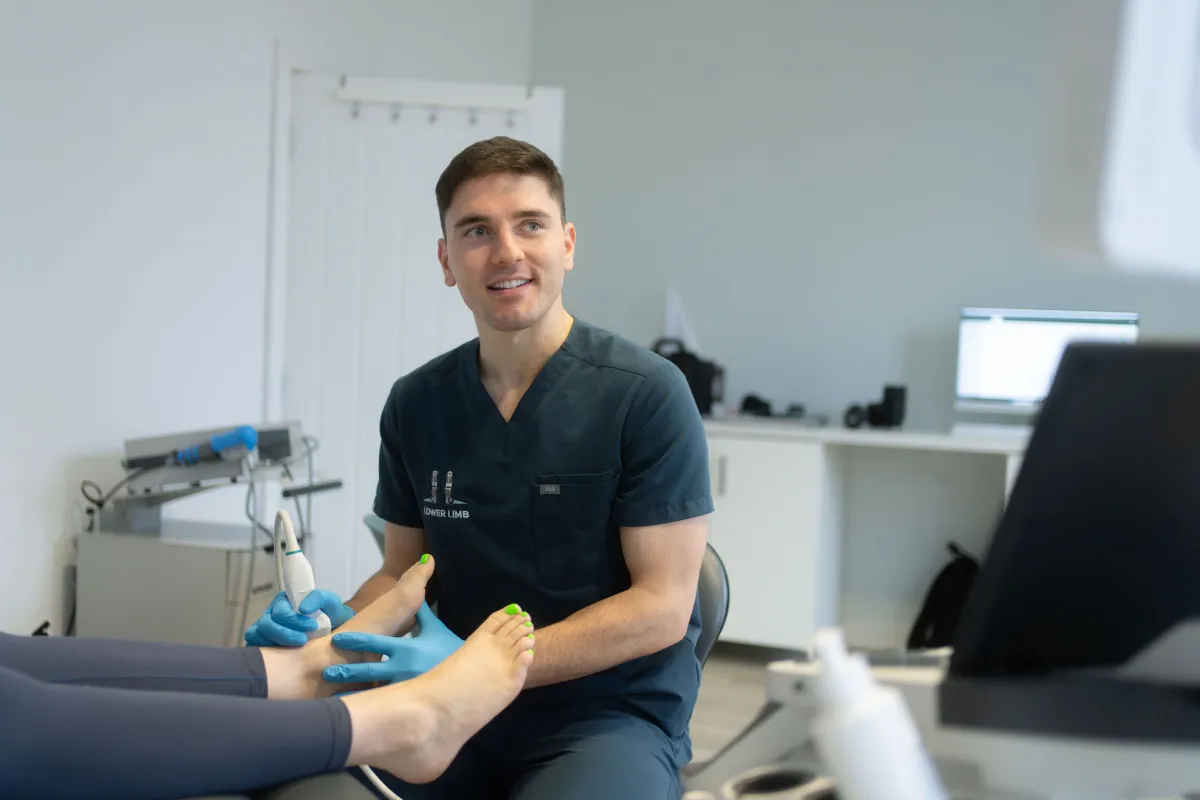
If you have focal pain that you can cover with one finger, pain that is getting worse despite rest, or pain at night, you should be assessed urgently. At Lower Limb Clinic, we use diagnostic ultrasound to assess the periosteum and can refer for MRI if a stress fracture is suspected.
When to get seen urgently
If your shin pain is getting worse despite rest, hurts to walk, is present at night, or is very localised to one spot, book an assessment as soon as possible. Continuing to run on a developing stress fracture can turn a 6-week recovery into a 6-month one.
Why Runners Get Shin Splints
MTSS is a loading problem. The bone is being asked to absorb more force than it can handle. The question is why. Here are the most common factors we see:
1. Training Load Errors
This is the number one cause. Doing too much, too soon. Runners who increase weekly mileage by more than 10%, suddenly add speed work or hills, or return to running after a break without building back gradually are at the highest risk. Bone takes longer to adapt to increased load than muscles do, so you can feel strong but still be overloading the bone.
2. Overpronation and Foot Mechanics
Excessive pronation increases the traction forces on the medial tibia from the muscles that attach there (soleus, tibialis posterior, flexor digitorum longus). This is where podiatric biomechanics is particularly relevant. A gait analysis shows exactly how your foot is loading the tibia, and custom orthotics can reduce those forces.
3. Running Surface
Hard surfaces increase impact loading. Many Belfast runners train on pavements and roads, which offer no shock absorption. If you are prone to shin pain, incorporating softer surfaces like grass, trails, or even the treadmill can help manage load during recovery.
4. Calf and Soleus Weakness
The calf muscles act as shock absorbers during running. When they fatigue, more force is transmitted directly to the bone. Soleus strength in particular is critical for distance runners because it is the primary propulsive muscle during the stance phase of running.
5. Low Bone Density Risk Factors
In some runners, particularly female athletes, MTSS and stress fractures can be related to relative energy deficiency in sport (RED-S), previously known as the female athlete triad. Low calorie availability, menstrual irregularity, and low bone density create a significantly higher risk of bone stress injuries. This is important and sometimes overlooked.
How We Treat MTSS at Lower Limb Clinic
Assessment
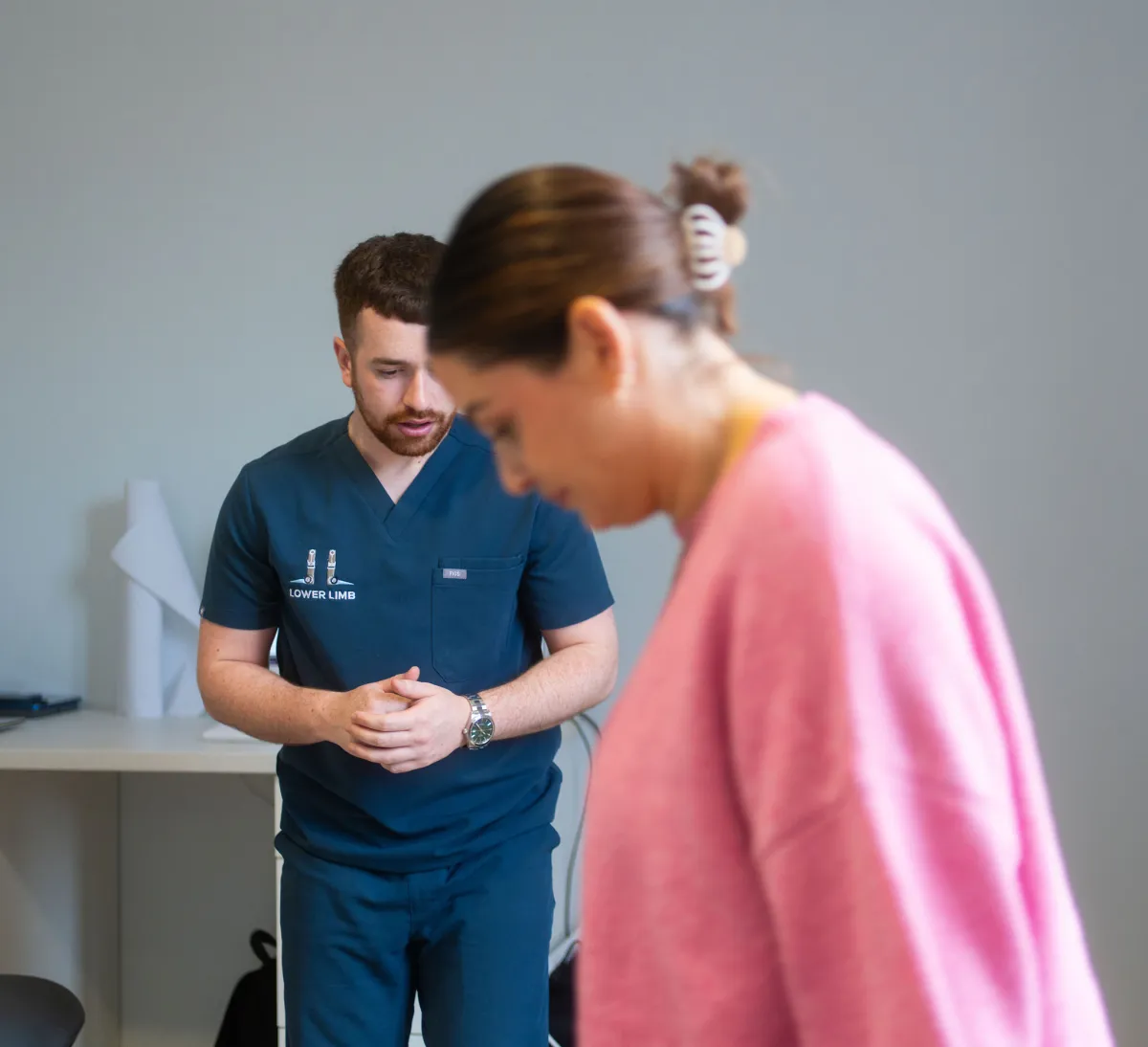
Every runner with shin pain gets a thorough clinical examination to establish where on the MTSS-to-stress-fracture spectrum they are. We test for focal tenderness, use the single-leg hop test, and assess with diagnostic ultrasound to check the periosteum. If we suspect a stress fracture, we refer for MRI.
We then run a full biomechanical assessment including video gait analysis to identify the mechanical factors driving the overload.
Treatment
- Load management: The first priority is reducing the load on the tibia to a level the bone can tolerate. This does not always mean complete rest. Many runners can continue at a reduced volume or switch to low-impact cross-training while we address the underlying causes.
- Calf and soleus strengthening: A progressive programme building the capacity of the muscles that protect the tibia from impact.
- Custom orthotics: If overpronation or tibial rotation is contributing, orthotics reduce the traction forces on the medial tibia. Research supports orthotic use for both treatment and prevention of MTSS in runners.
- Gait retraining: Increasing running cadence by 5-10% has been shown to reduce tibial loading significantly. We use video analysis to guide this.
- Shockwave therapy: For chronic cases that are slow to settle, shockwave therapy can stimulate bone remodelling and reduce periosteal pain.
- Graduated return-to-running plan: A structured programme that rebuilds running volume progressively, typically starting with walk-run intervals and increasing over 4-6 weeks.
Shin pain when running?
Get it checked before it gets worse. Our sports podiatrists can assess your shin pain, rule out a stress fracture, and identify the biomechanical causes. Book your assessment online or call 028 9013 9185.
How Long Does Recovery Take?
Mild MTSS (pain only during running, settles quickly afterwards) typically resolves in 3-4 weeks with load modification and a strengthening programme. Moderate cases take 6-8 weeks. Severe cases or those approaching stress fracture territory may need 8-12 weeks with a period of non-impact activity.
The most important thing is to not ignore it. Runners who push through shin pain and hope it goes away are the ones who end up with stress fractures and 3-month layoffs. Catching it early and addressing the cause makes a massive difference to recovery time.
Preventing Shin Splints
If you have had MTSS before, or you are ramping up training for a race, here is how to reduce your risk:
- Follow the 10% rule for weekly mileage increases
- Include regular calf and soleus strengthening (heavy slow calf raises are excellent)
- Vary your running surfaces where possible
- Replace running shoes every 500-700km
- Consider a biomechanical screening at Lower Limb Clinic before marathon or race training blocks
- If you are prone to MTSS, custom orthotics can be preventative, not just reactive
About the Author
Paul McMullan is a specialist MSK podiatrist and founder of Lower Limb Clinic, Belfast, with clinics on Lisburn Road and Ormeau Road. He holds an MSc in Podiatric Sports Medicine from Queen Mary University of London and is a Fellow of the Royal College of Physicians and Surgeons of Glasgow (FRCPSGlasg).
Disclaimer: This article is intended for general informational purposes only and does not constitute medical advice. If you have shin pain or any running injury, please seek assessment from a qualified healthcare professional.