You feel it first going downhill. Then on stairs. Then sitting at your desk for 20 minutes makes your kneecap ache. Eventually it hurts during every run, and you start shortening your routes, skipping sessions, or stopping altogether.
Patellofemoral pain syndrome (PFPS), commonly called runner's knee, is the single most common knee injury in runners. Studies suggest it accounts for up to 25% of all running-related injuries. At Lower Limb Clinic in Belfast, we see it almost every day.
The frustrating part? Most runners try rest, ice, maybe a knee strap from the chemist, and it comes back within weeks of returning to training. That is because PFPS is almost never a knee problem in isolation. It is a biomechanical problem, and until you find the root cause, it will keep returning.
What Is Patellofemoral Pain Syndrome?
PFPS is pain at the front of the knee, around or behind the kneecap (patella). The patella sits in a groove on the front of the femur and glides up and down as you bend and straighten your knee. When the forces acting on the patella are unbalanced, it tracks poorly through that groove. Over time, the cartilage on the underside of the kneecap becomes irritated, and you get pain.
The key word there is "unbalanced." Something is causing your kneecap to be loaded unevenly. Finding that something is where most treatment approaches fall short.
Why Runners Get PFPS
Running places repetitive load through the patellofemoral joint with every stride. At the point of foot strike, ground reaction forces travel up through the ankle, tibia, and into the knee. If there is a problem anywhere in that chain, the knee absorbs the consequences.
The most common causes we identify at Lower Limb Clinic:
1. Weak Glutes and Hip Stabilisers
This is the big one. When the gluteus medius is weak, the hip drops on the opposite side during single-leg stance (which is what running is, over and over). That hip drop causes the knee to collapse inward, increasing the lateral pull on the patella. You can stretch and foam roll all you want, but if the glutes are not strong enough to control hip position at speed, the knee will keep suffering.
2. Overpronation at the Foot
Excessive pronation (rolling in) at the foot causes internal rotation of the tibia, which increases the torsional load on the knee. This is where podiatry and biomechanics come together. A gait analysis can show exactly how much your foot mechanics are contributing to the problem, and custom orthotics can control it.
3. Training Errors
Too much, too soon. Runners who ramp up mileage by more than 10% per week, add hills or speed work without adequate base fitness, or return to full volume after a break are significantly more likely to develop PFPS. The patellofemoral joint simply is not conditioned for the load being placed on it.
4. Quadriceps Imbalance
The VMO (vastus medialis oblique), the teardrop-shaped muscle on the inner side of the knee, plays a critical role in stabilising the patella. When it is weak relative to the outer quad, the patella gets pulled laterally. Targeted strengthening of the VMO is a core part of rehabilitation.
5. Tight Lateral Structures
A tight IT band, lateral retinaculum, or lateral quad can pull the patella outward. This often coexists with weak medial structures, creating a double problem.
Why Rest Alone Does Not Work
Here is the problem with just resting. PFPS is not an acute injury like a muscle tear that heals with time. It is a loading problem caused by structural and biomechanical factors that do not change while you sit on the sofa. When you return to running, the same forces act on the same poorly-tracking kneecap, and the pain returns.
Rest reduces inflammation, and you feel better temporarily. But it does not address the cause. That is why PFPS has such a high recurrence rate, with some studies reporting up to 70-90% of runners experiencing return of symptoms within 12 months of initial treatment if only rest and pain relief are used.
How We Treat Runner's Knee at Lower Limb Clinic
Our approach addresses the full kinetic chain, not just the knee.
| Assessment | What We Look For |
|---|---|
| Clinical examination | Patellar tracking, crepitus, joint line tenderness, muscle strength testing |
| Video gait analysis | Foot strike pattern, cadence, hip drop, knee alignment during running |
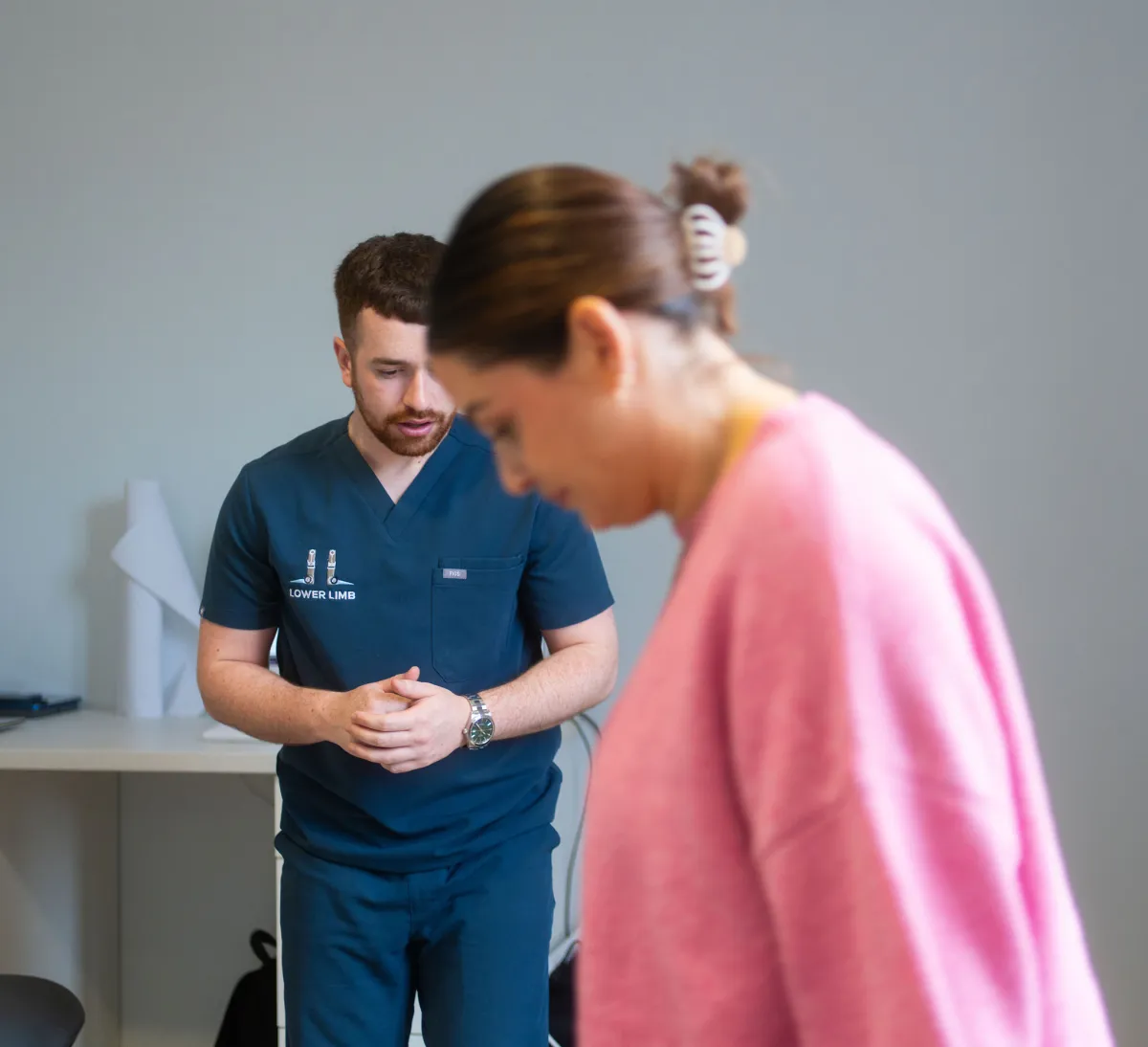
| Biomechanical assessment | Pronation, tibial rotation, hip and glute strength, flexibility |
| Diagnostic ultrasound | Soft tissue assessment if tendinopathy or bursitis is suspected |
Based on what we find, treatment typically includes:
- Targeted strengthening: A progressive programme focusing on glute, VMO, and hip stabiliser strength. This is the most evidence-supported intervention for PFPS and the part that most runners skip.
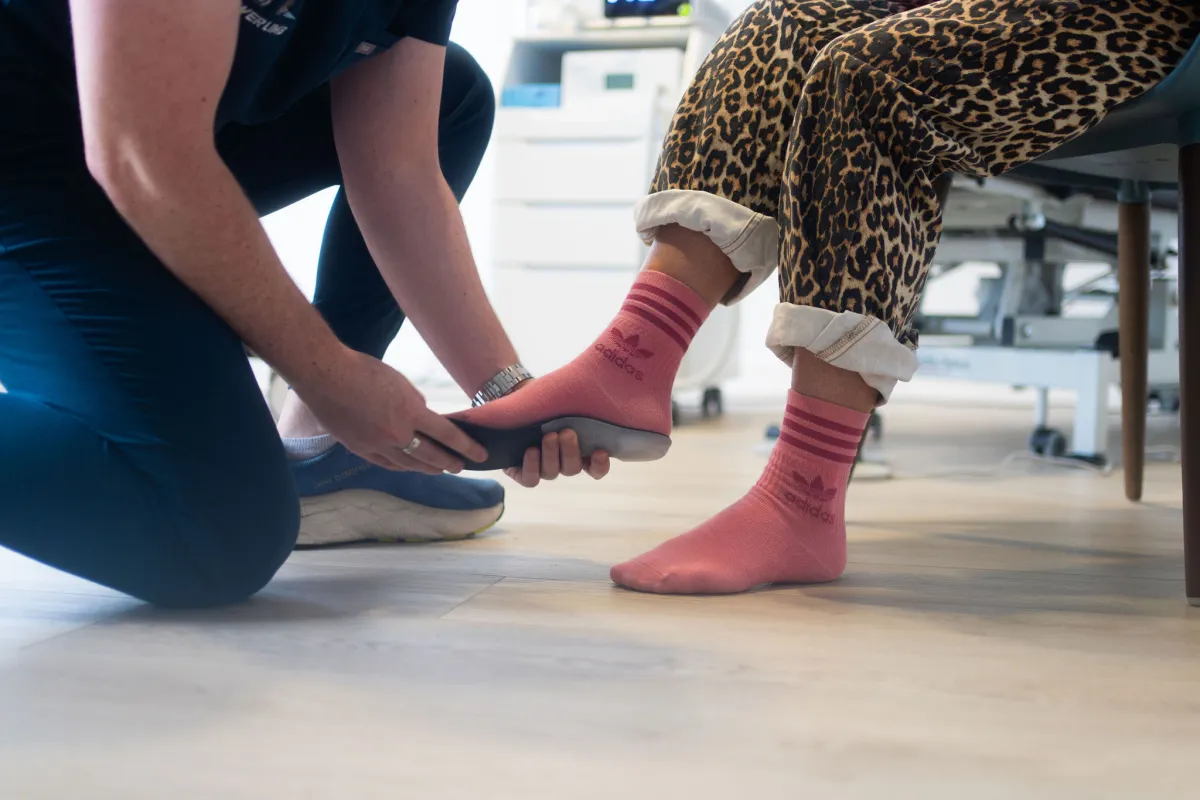
- Custom orthotics: If overpronation or foot mechanics are contributing, a pair of custom 3D-printed orthotics can reduce tibial rotation and take load off the patellofemoral joint. Manufactured in-house at Realta Labs.
- Running technique modification: Small changes to cadence, foot strike, or step width can significantly reduce patellofemoral load. We use video gait analysis to guide this.
- Shockwave therapy: For cases with associated patellar tendinopathy, shockwave can accelerate healing and reduce pain.
- Graduated return-to-running plan: A structured programme that progressively increases load so the knee adapts rather than reacts.
Knee pain when running?
Our sports podiatrists can identify whether your knee pain is biomechanical and build a plan to fix it. Book your assessment online or call 028 9013 9185.
How Long Does Recovery Take?
With a proper rehabilitation programme, most runners see significant improvement in 6-8 weeks. Full return to pre-injury mileage usually takes 10-12 weeks. The key is not rushing back. Runners who follow a structured return-to-running plan have much lower recurrence rates than those who just "see how it feels."
Can You Prevent PFPS?
The best prevention is strength training. Runners who include regular glute and hip work in their programme are significantly less likely to develop PFPS. Two to three strength sessions per week targeting the glutes, quads, and hip stabilisers makes a measurable difference.
A pre-season or pre-marathon biomechanical screening at Lower Limb Clinic can also identify risk factors before they become injuries. If you are training for the Belfast Marathon, a parkrun PB, or just want to run pain-free, it is worth getting checked.
About the Author
Paul McMullan is a specialist MSK podiatrist and founder of Lower Limb Clinic, Belfast, with clinics on Lisburn Road and Ormeau Road. He holds an MSc in Podiatric Sports Medicine from Queen Mary University of London and is a Fellow of the Royal College of Physicians and Surgeons of Glasgow (FRCPSGlasg).
Disclaimer: This article is intended for general informational purposes only and does not constitute medical advice. If you have knee pain or any running injury, please seek assessment from a qualified healthcare professional.