It usually starts quietly. You notice your foot looks a little different in photographs. Shoes that fitted perfectly two years ago now press uncomfortably on the side of your big toe. You find yourself sizing up every pair in the shop not by style, but by whether the toe box will accommodate that bump. Sandals season arrives and, for the first time, you hesitate.
If this sounds familiar, you are in remarkably large company. A landmark systematic review published in the Journal of Foot and Ankle Research (Nix et al., 2010) pooled data from over 496,000 participants and found that hallux valgus — the medical name for a bunion — affects approximately 23% of adults aged 18 to 65, rising to 36% in those over 65. It is one of the most common structural foot problems we see at Lower Limb Clinic, and one of the most misunderstood.
Patients arrive at our Belfast clinics having been told two contradictory things: that nothing can be done short of surgery, or that a £15 corrector splint from Amazon will straighten the toe. Neither is true. This guide explains what a bunion actually is, why yours is probably not your fault, what genuinely helps, what is a waste of money, and — when the time comes — what modern, evidence-based surgery looks like.
1 in 4
adults aged 18–65 have some degree of hallux valgus
90%
of bunion patients have a positive family history
0
splints or correctors proven to straighten the toe
85–90%
satisfaction rates for modern, well-selected surgery
What a Bunion Actually Is (And Why It's Not Just a Bump)
A bunion is not a growth of extra bone, which is the most common misconception we correct in clinic. It is a progressive change in the alignment of the first ray — the column of bone running from your midfoot to your big toe.
Two things happen simultaneously. The first metatarsal (the long bone behind the big toe) drifts inwards, away from the second metatarsal, while the big toe itself angles outwards, towards the lesser toes. The 'bump' you see is largely the head of the first metatarsal becoming prominent as the joint uncovers — not new bone being laid down, although some bony remodelling does occur over time.
Because the deformity is three-dimensional and rotational — modern research has confirmed the metatarsal doesn't just drift sideways, it rotates — this explains why simple devices that push the toe straight cannot correct it. You cannot splint a rotated bone back into position any more than you can un-twist a corkscrew by pulling on it.
The Adventitious Bursa: Why Some Bunions Hurt More Than Others
Here is something that surprises many patients: the size of a bunion correlates poorly with how much it hurts. We regularly see large, long-standing bunions that cause no pain at all, and modest ones that are exquisitely tender. One of the most common reasons is an adventitious bursa.
An adventitious bursa is a fluid-filled sac that the body forms in response to repeated friction and pressure — in this case, between the prominent metatarsal head and the shoe. When this bursa becomes inflamed (bursitis), the overlying skin becomes red, swollen, warm and sensitive to even light touch. Patients often describe a burning or throbbing sensation that persists after shoes come off in the evening.
This distinction matters enormously for treatment, because an inflamed bursa is highly treatable without surgery. Reduce the friction, settle the inflammation, and a 'painful bunion' can become a painless one — even though the bony alignment hasn't changed. This is why an accurate diagnosis, rather than an assumption, should always come first.
Is it the joint, the bursa, or something else?
Pain at the big toe joint can also come from early osteoarthritis, capsulitis, sesamoid problems or gout. Our assessment includes diagnostic ultrasound to identify exactly which structure is generating your pain. Book an assessment online or call 028 9013 9185.
"Did My Shoes Cause This?" — The Role of Genetics
Almost every patient asks this, usually with a note of guilt. The honest answer: probably not — your genes loaded the gun; footwear at most pulled the trigger.
A study by Piqué-Vidal and colleagues published in the Journal of Foot and Ankle Surgery examined 350 patients with hallux valgus and found that 90% had a positive family history, with the pattern of inheritance most consistent with an autosomal dominant trait with incomplete penetrance — in plain English, it runs strongly in families but doesn't affect every member equally. Large-scale work from the Framingham Foot Study has similarly confirmed that hallux valgus is significantly heritable, particularly in women.
What you inherit is not the bunion itself but the architecture that predisposes to it: ligament laxity, a hypermobile first ray, a rounded metatarsal head, flat feet or a pronated gait pattern that repeatedly loads the inside of the forefoot. Footwear — particularly narrow, tapered toe boxes and heels above 5cm — then acts as an accelerant on that underlying biology. This is why bunions appear in populations that have never worn fashion shoes, and why some lifelong stiletto wearers never develop them.
Two practical implications follow. First, stop blaming yourself. Second, if your mother or grandmother had significant bunions and you are noticing early drift in your twenties or thirties, this is precisely the window where conservative management has the most to offer — addressing the mechanics before the deformity progresses.
The Footwear Problem Nobody Talks About Honestly
Let's address the part of bunion life that clinical articles usually skip: it changes your relationship with shoes, and that has a real emotional cost.
We hear it weekly in clinic. The bridesmaid who dreads the shoes chosen for the wedding. The professional whose office dress code assumes footwear her forefoot can no longer tolerate. The man who has quietly gone up a full shoe size — not because his feet grew, but to buy width — and now walks in shoes that slip at the heel.
The woman who says, "I just don't wear sandals anymore," as if it were a small thing. It isn't a small thing. Research consistently shows hallux valgus is associated with reduced foot-specific and general quality of life, and footwear restriction is a large part of why.
Our advice is pragmatic, not puritanical:
- Judge shoes by the toe box, not the size on the label. The widest part of your foot should sit in the widest part of the shoe, with the upper made of a material that yields (leather, knit, mesh) rather than one that fights back (patent, rigid synthetics).
- The 'insole test' takes ten seconds. Pull the insole out of the shoe and stand on it. If your forefoot overhangs the edges, the shoe will compress the bunion — however comfortable it feels in the shop.
- Heel height matters more than heel existence. Every centimetre of heel shifts load towards the forefoot. Below 3–4cm the effect is modest; above 5cm forefoot pressure rises steeply. You don't need to live in flats — you need to be strategic about when you spend your 'heel hours'.
- Keep 'occasion shoes' for occasions. A narrow shoe worn for three hours at a wedding is a pressure event your foot will recover from. The same shoe worn nine hours a day, five days a week, is a progressive deforming force.
- Several brands now build genuinely foot-shaped shoes that don't look orthopaedic — wide-toe-box trainers and dress-adjacent styles have improved dramatically in the past five years. We keep an updated list and give specific recommendations at every bunion assessment.
And on aesthetics: a well-fitted shoe over a settled, pain-free bunion looks considerably better than any shoe over a foot that is red, swollen and being limped on. Comfort and appearance are not opposites here — the inflamed bunion is what draws the eye.
How We Assess a Bunion Properly
A meaningful bunion assessment answers four questions: How advanced is the deformity? What is generating the pain? What is driving the progression? And what does this patient actually need — reassurance, conservative care, or a surgical opinion?
Clinical and Biomechanical Examination
We assess the joint's range and quality of motion, the mobility of the first ray, the position and function of the sesamoid bones beneath the joint, and — critically — how your whole lower limb behaves when you walk. Pressure-plate gait analysis shows us where load is actually travelling through your forefoot. A foot that pronates heavily and 'rolls off' the inside of the big toe with every step applies a deforming force thousands of times a day; identifying and addressing that is central to slowing progression.
X-ray: Grading the Deformity
Weight-bearing X-rays remain the gold standard for staging hallux valgus, and we arrange referral when the findings will change management. Two angles matter most:
| Severity | Hallux Valgus Angle (HVA) | Intermetatarsal Angle (IMA) |
|---|---|---|
| Normal | < 15° | < 9° |
| Mild | 15–20° | 9–11° |
| Moderate | 20–40° | 11–16° |
| Severe | > 40° | > 16° |
These measurements matter because they guide surgical decision-making — different procedures suit different grades — and because they give us an objective baseline. If we repeat imaging in three years and the angles are stable, that is genuinely reassuring information.
Diagnostic Ultrasound: Seeing the Soft Tissue X-ray Misses
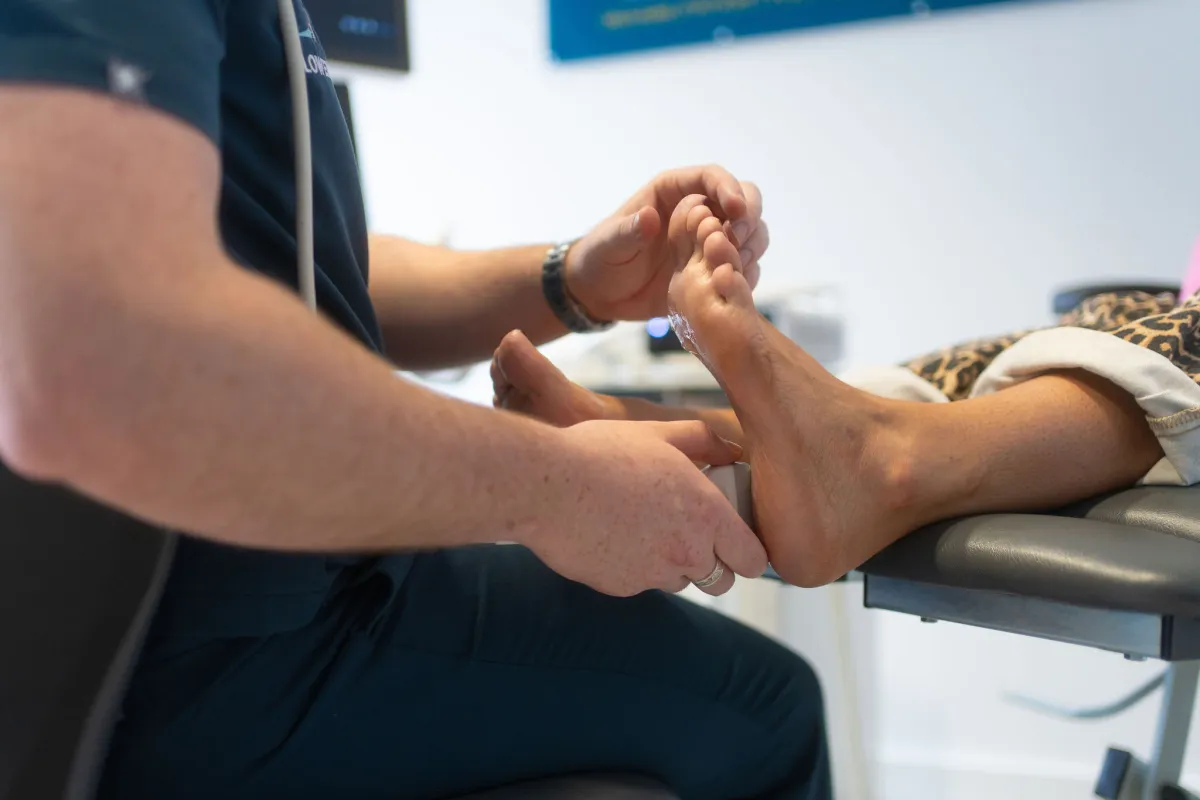
X-ray shows bone alignment beautifully but says almost nothing about why the joint hurts today. This is where in-clinic diagnostic ultrasound earns its place. In a bunion assessment, ultrasound lets us directly visualise:
- An adventitious bursa — its size, and whether it contains inflammatory fluid
- Joint synovitis — active inflammation within the joint capsule itself
- Early cartilage and joint-surface change suggesting degenerative involvement
- Sesamoid position and pathology beneath the joint
- Associated problems such as capsulitis of the second toe joint, which frequently develops as load transfers away from a failing big toe
Because we scan at the point of care, you see the images with us, in the room, at the same appointment. Patients consistently tell us that seeing the inflamed bursa — rather than being told vaguely that the area is 'irritated' — transforms their understanding of the problem and their confidence in the plan.
Conservative Treatment: What the Evidence Actually Supports
First, the honest headline: no non-surgical treatment has been shown to reverse the bony deformity. Anyone selling you straightening is selling you false hope. But that is not the same as saying nothing works — because for most people the goal that matters is not a straighter X-ray, it is a comfortable foot that lets you live your life. Against that goal, conservative care performs well.
1. Settling the Acute Problem
When an adventitious bursitis flares, the priorities are deloading and settling inflammation: temporary footwear modification, protective padding or bunion sleeves (useful as cushioning, not correction), activity modification, ice and, where appropriate, short courses of anti-inflammatory medication. For a stubborn, ultrasound-confirmed bursitis or joint synovitis that fails these measures, a precisely placed ultrasound-guided corticosteroid injection can settle inflammation that months of padding cannot — with the guidance ensuring the medication goes exactly where the pathology is.
2. Custom Orthotics: Changing the Forces, Not the Bone
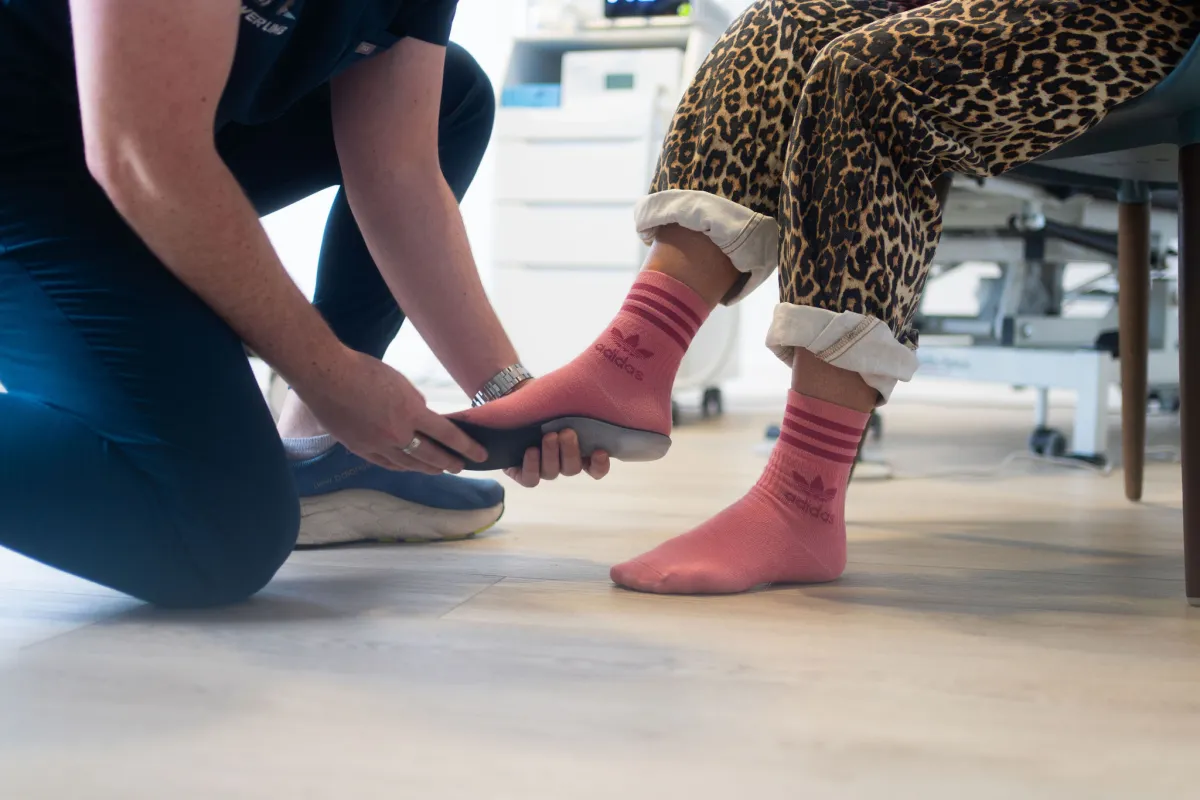
This is where the most common misunderstanding lives, so let us be precise about what custom orthotics do and don't do for bunions. They do not push the toe straight. What a well-prescribed orthotic does is change the way load travels through the first ray during gait — reducing the pronatory forces and first-ray overload that both aggravate symptoms and contribute to progression.
For the right foot — typically the flatter, more flexible, harder-pronating foot — this achieves three things: it reduces day-to-day pain, it improves the function of the big toe joint during push-off, and it addresses the mechanical environment in which the deformity is progressing. Because we design and 3D-print our orthotics in-house at our Belfast lab, we can build in bunion-specific features — first-ray accommodations, precise forefoot posting, cluffed extensions — and adjust them at fitting rather than posting devices back and forth to an external lab for weeks.
3. Foot Strengthening: The Most Under-Prescribed Treatment
If orthotics change the passive forces, strengthening changes the active ones — and it is the piece almost nobody is offered. The key muscle is abductor hallucis, which runs along the inside arch and, when working well, pulls the big toe away from the lesser toes — directly opposing the bunion's direction of drift. Research (including work by Glasoe and colleagues in Physical Therapy) supports targeted strengthening as a rational component of early hallux valgus management, and studies of exercise programmes in mild-to-moderate bunions have shown meaningful improvements in pain and function, with some evidence of modest angular improvement in early, flexible deformities.
A typical programme we prescribe includes:
The 'short foot' exercise
Learning to dome the arch without curling the toes — activating the deep intrinsic muscles that stabilise the forefoot.
Toe abduction work ('toe spreading')
Actively drawing the big toe away from the second — initially with finger or spacer assistance, progressing to unassisted holds. This directly trains abductor hallucis against the direction of drift.
Big-toe press-downs
Driving the big toe into the floor while the lesser toes stay relaxed — rebuilding the push-off strength a bunion gradually steals.
Calf and posterior-chain loading
A stiff ankle offloads into the forefoot with every step — restoring calf flexibility and strength reduces that transfer.
Balance progression
Single-leg work that forces the foot's stabilising muscles to do their job rather than letting the shoe do it for them.
Ten focused minutes a day, most days, for three months is the honest dose. This is not a quick fix; it is the closest thing bunion care has to an investment account.
4. Spacers, Splints and Correctors: An Honest Verdict
✓ Worth buying — for comfort
Silicone toe spacers and gel sleeves reduce friction between the toes and cushion the prominence against the shoe. Many patients find them genuinely comfortable for day-to-day wear. Around £10, and if you like them, use them.
~ Marginal
Rigid night splints hold the toe straighter while you sleep and may ease morning stiffness — but controlled studies show the correction does not survive standing up. No lasting change in alignment.
✗ Don't waste your money
'Bunion correctors' promising permanent straightening. The evidence is emphatic: they do not deliver it. A rotated bone cannot be splinted straight. Buy for comfort, never for correction.
A realistic conservative goal
Comfortable in your preferred daily footwear, walking without compensation, sleeping without throbbing, and progression slowed — with the deformity itself unchanged. For the majority of bunion patients we see, this is achievable without an operation.
When Surgery Becomes the Right Answer
There is a persistent myth that bunion surgery is 'not worth it' — usually based on someone's aunt's operation in 1995. Modern hallux valgus surgery, properly selected and properly performed, has patient satisfaction rates of 85–90% in published series. The key phrase is properly selected. We suggest a surgical opinion when:
- Pain persists despite a genuine trial of conservative care — not one pair of insoles, but a properly executed programme over months
- The deformity is progressing — objectively, on serial assessment
- Secondary problems are developing — the second toe hammering or being pushed out of place, transfer pain under the ball of the foot, recurrent bursitis
- Footwear restriction is genuinely limiting your life — and you have exhausted sensible footwear strategies
Two things surgery should not be done for: appearance alone (professional bodies including the Royal College of Podiatry advise against purely cosmetic bunion surgery — every operation carries risk, and a painless bunion rarely justifies it) and prevention ("getting it done before it gets bad" — an asymptomatic bunion may never become symptomatic).
Modern, Research-Based Procedures
There are over 100 described bunion operations, which tells you no single one is perfect. In contemporary practice, four approaches dominate, matched to deformity severity and joint quality:
| Procedure | Best Suited To | How It Works | What the Evidence Says |
|---|---|---|---|
| Distal chevron osteotomy | Mild–moderate deformity | V-shaped cut near the metatarsal head shifts it back over the sesamoids; fixed with a screw | Long track record; reliable correction and high satisfaction in appropriately selected mild–moderate cases |
| Scarf (± Akin) osteotomy | Moderate–severe deformity | Z-shaped cut along the metatarsal shaft allows powerful, stable realignment; often paired with a small wedge (Akin) in the toe bone | The workhorse of UK bunion surgery; large series show durable correction and good function |
| Minimally invasive (MICA / keyhole) | Mild–severe, surgeon-dependent | The same corrections performed through 3–5mm incisions using a burr under X-ray guidance | Randomised trial data (including a 2022 RCT in JAMA-family literature and multiple UK series) shows equivalent correction to open scarf with smaller scars and, in several studies, less early pain; technique is skill-dependent |
| Lapidus (first TMT fusion) | Severe deformity, hypermobile first ray, recurrence | Corrects the deformity at its origin by fusing the unstable joint at the base of the metatarsal, including rotational correction | Modern triplanar Lapidus systems report low recurrence rates precisely because they address all three planes of the deformity |
Recovery expectations have also modernised: most first-ray osteotomies allow immediate protected weight-bearing in a post-operative shoe, transition to trainers around 6–8 weeks, and return to impact sport around 3–4 months — though swelling genuinely takes 6–12 months to fully settle, and honest surgeons say so.
We do not perform bunion surgery at Lower Limb Clinic — and that is precisely why our advice on it is worth having. We have no procedure to sell you. Our role is to exhaust the conservative options that most patients have never properly been offered, to stage your deformity objectively with imaging, and — if surgery becomes the right answer — to refer you to the appropriate foot and ankle surgeon with a complete biomechanical workup, then manage your rehabilitation and orthotic care afterwards to protect the result. (Recurrence risk is lower when the mechanics that drove the original deformity are addressed — which is rehabilitation and orthotic territory, not surgical territory.)
Your Questions, Answered Honestly
Can a bunion go away on its own?
No. Hallux valgus is a structural change and does not reverse spontaneously. However, bunion pain very often can resolve completely with conservative care — and a painless bunion needs monitoring, not treatment.
Will it definitely get worse?
Not necessarily. Bunions progress at wildly different rates; some barely change over decades. Known risk factors for faster progression include ligament laxity, significant flatfoot, and family history of severe deformity. This is exactly what serial assessment is for.
Do bunion correctors from the internet work?
For straightening the toe: no — the evidence is clear that any correction disappears when the device comes off. For comfort: soft spacers and sleeves can genuinely help, and are cheap. Buy for comfort, never for correction.
Are orthotics worth it if they can't straighten the toe?
If your pain is activity-related and your foot mechanics are contributing — which our assessment establishes objectively — yes. The goal is a comfortable, well-functioning foot and a slower progression curve, and for that the evidence and our clinical experience are both supportive. We wrote an honest full guide on this: Are Custom Orthotics Worth It?
How do I know if the bump pain is bursitis or arthritis?
You often can't tell from the outside — which is precisely why we scan. Bursitis pain tends to be pressure-related, over the prominence, with visible redness and swelling; joint arthritis tends to hurt through movement, deep in the joint, with stiffness. Ultrasound distinguishes them in minutes, and the treatments differ significantly.
My teenager is developing a bunion. Should I worry?
Juvenile hallux valgus is strongly hereditary and worth taking seriously precisely because there are so many loading years ahead. Early biomechanical assessment, footwear guidance and strengthening are most valuable at exactly this age. Bring them in.
How much does a bunion assessment cost in Belfast?
Our full biomechanical assessments — including ultrasound where indicated — are listed on our prices page. No GP referral is needed, and most private health insurers including Bupa and WPA cover podiatric assessment.
The Short Version
- A bunion is a rotational realignment of bone, not a growth — and no splint can straighten it.
- Pain often comes from an inflamed adventitious bursa, which is highly treatable without surgery. Ultrasound tells us exactly what's hurting.
- Genetics loaded the gun — around 90% of patients have a family history. Footwear accelerates; it rarely causes.
- What works conservatively: footwear strategy, custom orthotics, and three months of targeted strengthening. What doesn't: correctors promising straightening.
- Surgery is for persistent pain despite proper conservative care — and modern procedures, well selected, satisfy 85–90% of patients.
Stop guessing about your bunion
One appointment gives you a staged deformity, an ultrasound-confirmed pain source, and an honest plan — whether that's reassurance, a conservative programme, or a well-prepared surgical referral. Book online at our Lisburn Road or Ormeau Road clinics, or call 028 9013 9185.
About the Author
Paul McMullan is a specialist MSK podiatrist and founder of Lower Limb Clinic, Belfast, with clinics on Lisburn Road and Ormeau Road. He holds an MSc in Podiatric Sports Medicine from Queen Mary University of London and is a Fellow of the Royal College of Physicians and Surgeons of Glasgow (FRCPSGlasg). He has over 15 years' experience in the assessment and conservative management of forefoot deformity, including diagnostic ultrasound and custom orthotic prescription.
Disclaimer: This article is intended for general informational purposes only and does not constitute medical advice. Treatment decisions, including any decision about surgery, should be made in consultation with a qualified healthcare professional following individual assessment. Clinical evidence cited reflects published research at the time of writing.