
What Is Haglund's Deformity?
Haglund's deformity is a bony enlargement of the back of the heel bone (calcaneus), at the posterosuperior corner just above where the Achilles tendon attaches. Because rigid-backed shoes press on this prominence, it picked up the nickname "pump bump", after the stiff court pumps that aggravate it.
The bony bump on its own is often painless. The pain usually comes from what sits between the bone and the tendon: the retrocalcaneal bursa (a small fluid-filled cushion that becomes inflamed when compressed) and the insertional Achilles tendon (which can degenerate where it meets the heel). When the bony prominence, the bursitis and insertional Achilles tendinopathy occur together, the combination is sometimes called Haglund's syndrome.
This distinction matters, because the most effective treatment targets the irritated soft tissue and the mechanical forces compressing it, not the bone itself. Finding a prominent heel shape on imaging does not automatically explain your pain, and surgery to reduce the bone is rarely the first or best answer.
Classic Symptoms
- A firm, often visible bump on the back of the heel, sometimes red or swollen
- Pain at the back of the heel that flares with stiff or rigid-backed shoes
- Tenderness just above the heel where the Achilles tendon attaches
- Stiffness and pain in the first steps in the morning or after rest
- Pain that worsens with hill running, sprinting or pushing off
Signs You Need Specialist Assessment
- Back-of-heel pain lasting longer than four to six weeks despite footwear changes
- Pain limiting your work, walking or training
- Marked swelling, warmth or redness over the bump
- A sense of weakness, or pain when rising onto your toes
- Diabetes, inflammatory arthritis or neuropathy, where heel pain can signal different pathology
Why the Bump Itself Is Rarely the Whole Story
Plenty of people have a prominent posterior heel and no pain at all. When the back of the heel does hurt, the pain generators are usually the retrocalcaneal bursa and the insertional Achilles tendon being squeezed between the bony prominence and the heel counter of a shoe.
That is why two patients with an identical-looking bump can need completely different treatment. One may have an inflamed bursa that settles quickly with offloading and a footwear change. Another may have established insertional Achilles tendinopathy that needs a structured loading programme and shockwave. Treating both the same way is how heel pain ends up dragging on for months.
Structures and conditions we check for:
- Retrocalcaneal bursitis: Inflammation of the bursa between the heel bone and the Achilles tendon. The most common early pain source.
- Insertional Achilles tendinopathy: Degeneration of the tendon at its attachment, often with calcification visible on imaging.
- Posterior (dorsal) calcaneal spur: A bony spur at the Achilles insertion, frequently seen alongside Haglund's.
- Superficial (subcutaneous) bursitis: Irritation between the skin and the tendon from direct shoe friction.
- Inflammatory enthesopathy: In psoriatic arthritis, reactive arthritis or ankylosing spondylitis, the Achilles insertion can be involved.
How We Diagnose Haglund's Deformity
Diagnostic Ultrasound Scanning
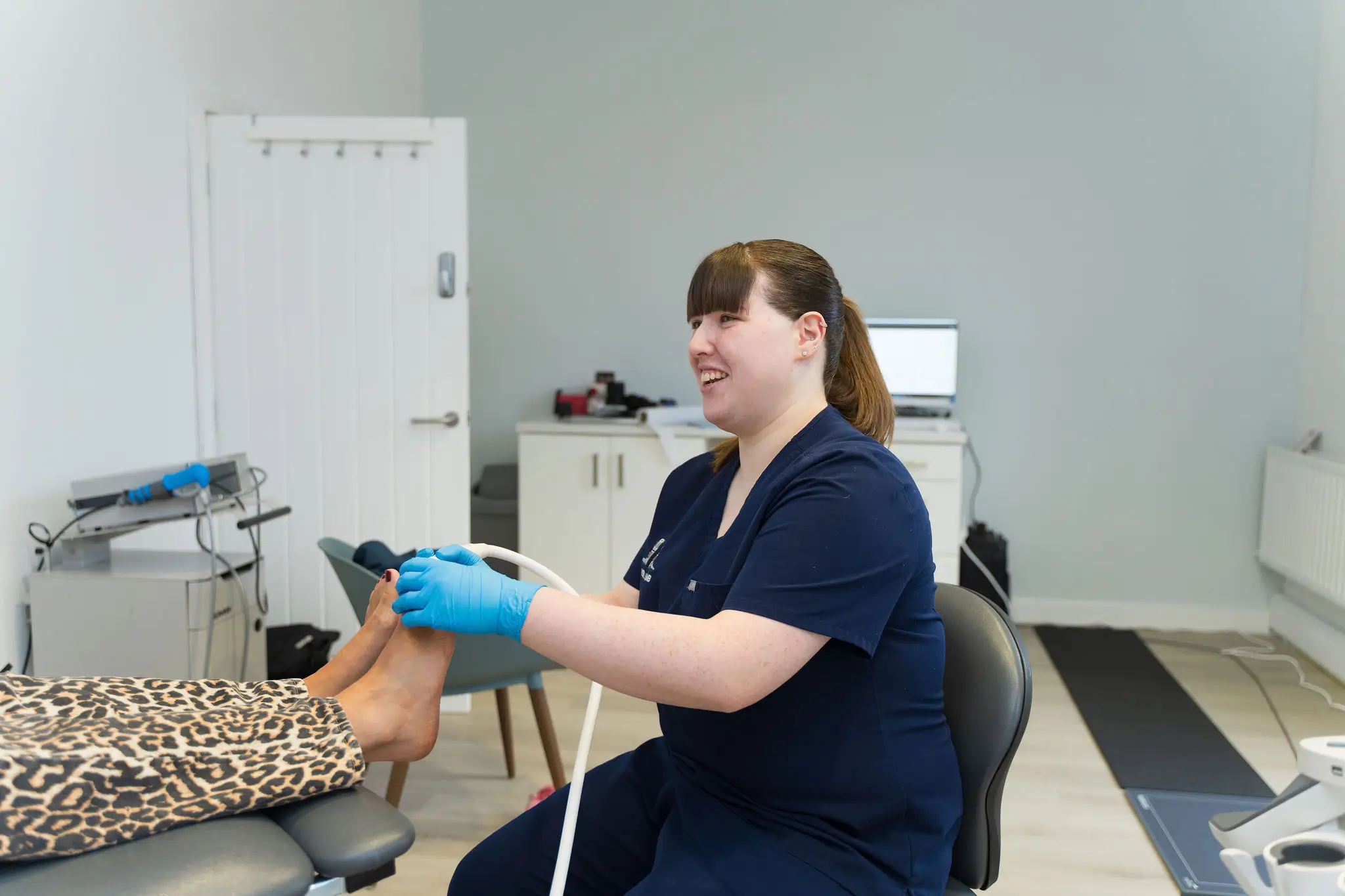
Every back-of-heel assessment at Lower Limb Clinic includes in-clinic diagnostic ultrasound. This lets us see the insertional Achilles tendon, the retrocalcaneal and superficial bursae and the bone surface in real time, during your first appointment, rather than weeks later after a separate referral.
We look for tendon thickening, hypoechoic (degenerative) change at the insertion, calcification, bursal fluid and increased blood flow on Power Doppler. Neovascularisation is a marker of active tissue pathology and helps us judge how irritable the tendon is and how to pace your loading programme.
Pressure Plate Gait Analysis
We map how force moves through your feet during standing and walking. A high-arched (cavus) foot, a stiff first ray or a tight calf complex all change how the Achilles insertion is loaded, and these patterns guide both orthotic prescription and your loading plan.
Clinical & Footwear Assessment
We assess ankle dorsiflexion (a tight calf is a key driver), heel alignment, tendon strength and the exact shoes you spend most time in. For Haglund's, footwear is often the single most modifiable factor, and identifying which shoes compress the prominence frequently produces fast relief.
Treatment Options
Footwear Modification & Offloading
Progressive Achilles Loading
Shockwave Therapy (ESWT)
Custom Orthoses & Heel Lift
Activity & Load Management
Surgical Referral When Indicated
A note on injections: corticosteroid injection directly into the Achilles insertion is generally avoided because of the risk to the tendon. Where an injection has a role, it is targeted and ultrasound-guided, and always combined with a loading programme.
Common Causes and Risk Factors
Foot Type & Mechanics
Footwear
Training Load
Systemic Factors
What to Expect at Your First Appointment
Detailed history
5 minClinical examination
5–10 minDiagnostic ultrasound
10 minPressure plate gait analysis
5 minDiagnosis & treatment plan
5 minRecovery and Prognosis
The outlook is good with the right diagnosis and a consistent plan. Bursitis driven mainly by footwear can settle within a few weeks once the compression is removed. Established insertional Achilles tendinopathy is slower and typically improves over 12 to 24 weeks of progressive loading, often supported by shockwave.
The biggest factors in recovery time are how long symptoms have been present before treatment, footwear, calf flexibility and consistency with the loading programme. We track progress with repeat ultrasound so decisions are based on measurable tissue change, not guesswork.
Your Clinicians
Paul McMullan BSc(Hons) MSc FRCPSGlasg MRCPod: Lead clinician with nearly 15 years of specialist experience in lower limb musculoskeletal conditions. Holds an MSc in Podiatric Sports Medicine from Queen Mary University of London. Experienced in diagnostic ultrasound, shockwave therapy and biomechanical assessment.
Darren Costello BSc(Hons) MSc PGCert MRCPSGlasg: MSc Sports and Exercise Medicine, with a postgraduate certificate from Brunel University in lower limb musculoskeletal assessment and a specialist interest in tendinopathy and orthotic therapy.
Why Patients Choose Lower Limb Clinic
Diagnostic ultrasound in every assessment
Treatment matched to the real pain source
Custom orthoses manufactured in-house
Shockwave therapy available
Surgery only when it is genuinely indicated
HCPC registered, Royal College members
Frequently Asked Questions
Common questions about Haglund's Deformity at Lower Limb Clinic.
Clinically reviewed by Paul McMullan, BSc(Hons) MSc FRCPSGlasg MRCPod
BSc (Hons) Podiatry · MSc Podiatric Sports Medicine (QMUL) · FRCPSGlasg · MRCPod
Lead Podiatrist & Clinical Director, Lower Limb Clinic Belfast