





What Is a Heel Spur?
A heel spur (calcaneal spur) is a bony growth that forms on the underside or back of the heel bone. These calcium deposits develop gradually over months and years, usually in response to repetitive strain on the plantar fascia or Achilles tendon where they attach to the calcaneus.
Here's what most people don't realise: heel spurs are remarkably common in people with no pain at all. Research consistently shows that around 15–25% of the general population have plantar heel spurs visible on X-ray, yet the majority experience no symptoms whatsoever. This is a critical point, because it means that finding a heel spur on imaging doesn't automatically explain your pain.
There are two distinct types of heel spur, and the distinction matters for treatment:
Plantar heel spurs grow on the underside of the calcaneus, at the origin of the plantar fascia. These are the most common type and are frequently found alongside plantar fasciitis, though the relationship between the two is more complex than simply "the spur causes the pain." Current evidence suggests the spur is a consequence of chronic fascial strain rather than the primary pain generator.
Posterior heel spurs (also called dorsal calcaneal spurs or Haglund's deformity–associated spurs) develop at the back of the heel where the Achilles tendon inserts. These are associated with insertional Achilles tendinopathy and can cause pain when shoes press against the back of the heel.
Classic Symptoms
- Pain on the underside of the heel, particularly with first steps in the morning or after prolonged sitting
- A sharp, stabbing sensation that may ease with movement but returns after rest
- Tenderness when pressing on the centre or inner edge of the heel
- For posterior spurs, a visible bump at the back of the heel with pain from shoe pressure
- Pain that worsens with prolonged standing or walking on hard surfaces
Signs You Need Specialist Assessment
- Your heel pain has lasted longer than four weeks despite rest and over-the-counter treatment
- Pain is affecting your ability to work, exercise, or walk comfortably
- You notice swelling, warmth, or redness around the heel
- The pain came on suddenly after an injury
- You have diabetes, inflammatory arthritis, or peripheral neuropathy, conditions where heel pain can indicate different underlying pathology
Why the Spur Itself Usually Isn't the Problem
This is perhaps the most important thing we explain to patients: in the vast majority of cases, removing or treating the spur itself is unnecessary. The pain comes from the soft tissue pathology surrounding the spur: inflamed plantar fascia, degenerative tendon tissue, fat pad atrophy, or nerve entrapment.
A landmark systematic review by Johal & Milner (2012) found no consistent correlation between the size of a heel spur and the severity of symptoms. Equally, surgical removal of heel spurs alone (without addressing the underlying fasciopathy) has a high recurrence rate. This is why our approach focuses on identifying and treating the true pain source rather than fixating on what appears on an X-ray.
Getting the diagnosis right determines whether your treatment will actually work. Treating plantar fasciitis with a stretching and loading programme is highly effective. Treating a calcaneal stress fracture with stretching is potentially harmful. Treating Baxter's nerve entrapment with shockwave therapy alone is unlikely to resolve it. This is why we use diagnostic ultrasound as a core part of every heel pain assessment.
Conditions that commonly coexist with or mimic heel spurs:
- Plantar fasciitis: The most common association. Thickening and degeneration of the plantar fascia at its calcaneal attachment.
- Plantar fat pad atrophy: Particularly in patients over 50. Thinning of the protective fat pad under the heel.
- Baxter's nerve entrapment: The first branch of the lateral plantar nerve, causing medial heel pain that mimics plantar fasciitis.
- Stress fracture of the calcaneus: A rare but important differential diagnosis.
- Insertional Achilles tendinopathy: For posterior spurs, degeneration at the tendon-bone junction.
- Inflammatory enthesopathy: In conditions like psoriatic arthritis, reactive arthritis, or ankylosing spondylitis.
How We Diagnose Heel Spurs
Diagnostic Ultrasound Scanning
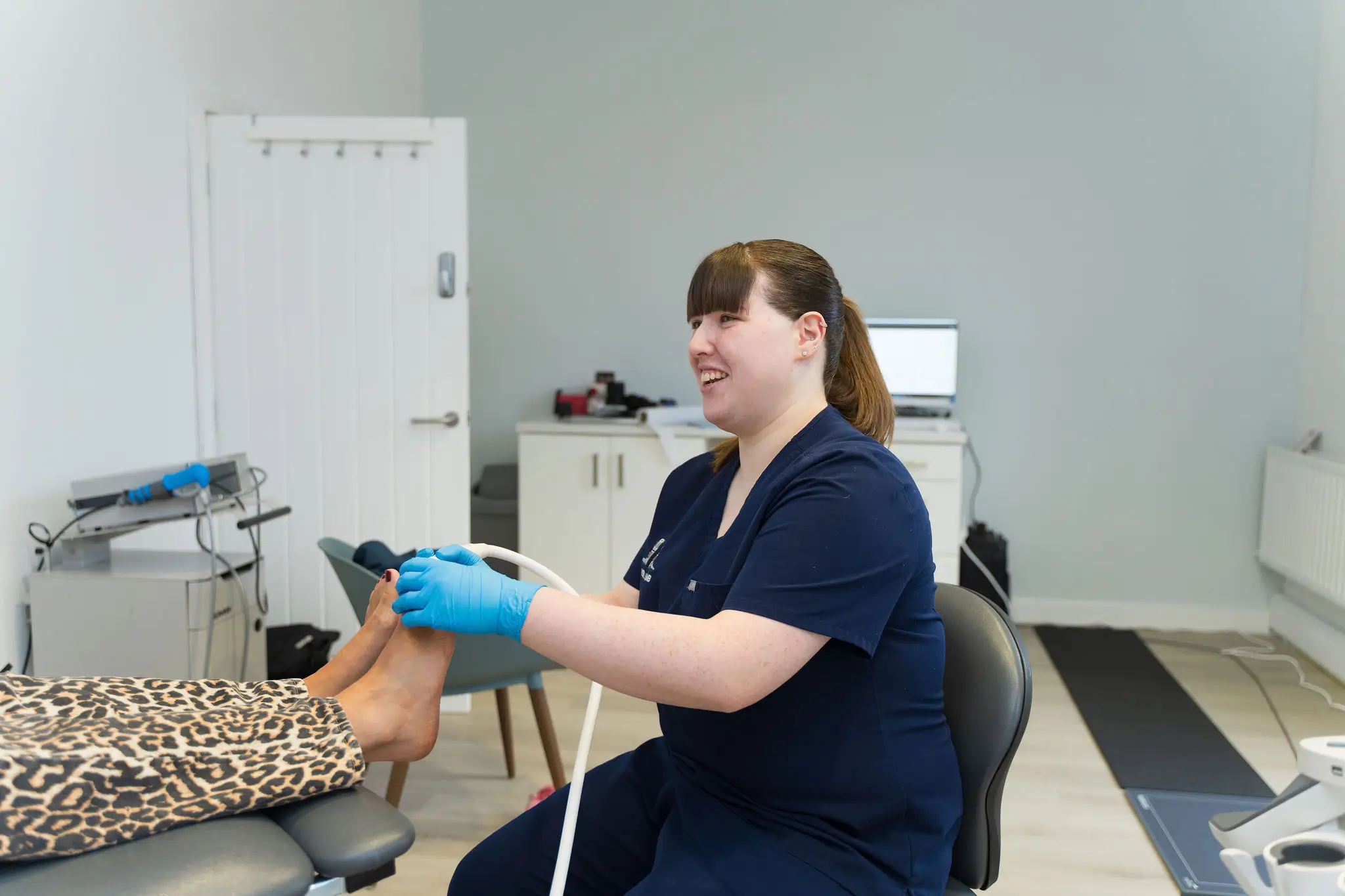
Every heel pain assessment at Lower Limb Clinic includes in-clinic diagnostic ultrasound. This allows us to visualise the plantar fascia, Achilles tendon, fat pad, and surrounding structures in real time, during your first appointment, not weeks later after a separate imaging referral.
Normal plantar fascia thickness measures approximately 3–4mm on ultrasound. In plantar fasciitis, the fascia typically thickens to 5mm or beyond, often with areas of hypoechoic (darker) degeneration visible within the tissue. We can also identify fascial tears, bursitis, fat pad changes, and assess blood flow using Power Doppler imaging. Increased vascularity (neovascularisation) is a marker of active tissue pathology and helps guide treatment decisions.
Ultrasound also identifies conditions that X-rays miss entirely: early stress reactions in the calcaneus, soft tissue masses, plantar fibromatosis (Ledderhose disease), and retrocalcaneal bursitis behind the heel.
Pressure Plate Gait Analysis
We use in-floor pressure plate technology to map exactly how forces distribute through your feet during standing and walking. This reveals asymmetries and abnormal loading patterns that contribute to chronic heel pain, such as excessive medial heel loading, late-phase forefoot overload, or compensatory gait patterns you may not be aware of.
This data directly informs orthotic prescription. Rather than using a generic arch support, we design orthoses based on your actual force distribution, targeting the specific mechanical factors driving your symptoms.
Clinical Biomechanical Assessment
A detailed assessment of foot and ankle range of motion, lower limb alignment, muscle strength, and functional movement. We assess dorsiflexion range at the ankle (tightness in the calf complex is one of the strongest risk factors for plantar fasciopathy), rearfoot motion, midfoot stability, and hip and knee alignment. This gives us the full biomechanical picture, not just what's happening at the heel, but why.
Treatment Options
Progressive Loading Programme
Shockwave Therapy (ESWT)
Custom Foot Orthoses
Corticosteroid Injection Therapy
Heel Padding and Offloading
Footwear Guidance
Common Causes and Risk Factors
Age & Body Composition
Occupation & Activity
Biomechanical Factors
Systemic Conditions
What to Expect at Your First Appointment
Detailed history
5 minClinical examination
5–10 minDiagnostic ultrasound
10 minPressure plate gait analysis
5 minDiagnosis & treatment plan
5 minRecovery and Prognosis
The prognosis for heel spur–related pain is excellent with appropriate treatment. Around 90% of plantar fasciopathy resolves with conservative (non-surgical) management. The key factors that influence recovery time include how long you've had symptoms before seeking treatment, accuracy of diagnosis, compliance with loading programmes, and addressing underlying biomechanical factors through orthotics and footwear.
Typical timelines: acute plantar fasciitis with early intervention, 6–12 weeks. Chronic plantar fasciopathy (over 6 months), 12–24 weeks. Fat pad atrophy, ongoing management. Insertional Achilles tendinopathy with posterior heel spurs, 12–24 weeks with progressive loading.
We monitor progress with repeat ultrasound scanning, tracking measurable changes in fascial thickness, echogenicity, and vascularity alongside your subjective pain scores. This means treatment decisions are based on objective tissue changes, not guesswork.
Your Clinicians
Paul McMullan BSc(Hons) MSc FRCPSGlasg MRCPod: Lead clinician with nearly 15 years of specialist experience in lower limb musculoskeletal conditions. Holds an MSc in Podiatric Sports Medicine from Queen Mary University of London. Fellow of the Royal College of Physicians and Surgeons of Glasgow. Experienced in diagnostic ultrasound, injection therapy, shockwave therapy, and biomechanical assessment.
Darren Costello BSc(Hons) MSc PGCert MRCPSGlasg: MSc Sports and Exercise Medicine, Member of the Royal College of Physicians and Surgeons of Glasgow, postgraduate certificate from Brunel University in lower limb musculoskeletal assessment. Specialist interest in biomechanical analysis and orthotic therapy for chronic heel conditions.
Why Patients Choose Lower Limb Clinic
Diagnostic ultrasound in every heel pain assessment
Treatment guided by what we see on ultrasound
Custom orthoses manufactured in-house
Shockwave therapy available
MSc-qualified clinicians
HCPC registered, Royal College members
Frequently Asked Questions
Common questions about Heel Spurs at Lower Limb Clinic.
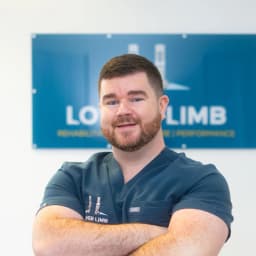
Clinically reviewed by Paul McMullan, BSc(Hons) MSc FRCPSGlasg MRCPod
BSc (Hons) Podiatry · MSc Podiatric Sports Medicine (QMUL) · FRCPSGlasg · MRCPod
Lead Podiatrist & Clinical Director, Lower Limb Clinic Belfast