It usually starts the same way. You are 3km into a run and you feel a niggle on the outside of your knee. You push through. Next run, it comes on at 2km. Then 1km. Eventually it hurts from the first step and you cannot run at all.
Iliotibial band syndrome (ITBS) is one of the most common overuse injuries in runners, accounting for roughly 12% of all running injuries. At Lower Limb Clinic in Belfast, it is one of the conditions we treat most frequently in our running population.
What Is the IT Band?
The iliotibial band is a thick strip of connective tissue (fascia) that runs down the outside of your thigh, from the hip to just below the knee. It is not a muscle. You cannot strengthen it, and despite what the internet says, you cannot effectively "stretch" it either. It is one of the strongest structures in the body.
The IT band crosses the lateral femoral epicondyle, a bony bump on the outside of your knee. When you bend and straighten your knee, the IT band slides across this bump. In ITBS, repeated compression and friction at this point causes irritation of the underlying fat pad and soft tissues, producing that characteristic sharp, localised pain.
What ITBS Feels Like
- Sharp or burning pain on the outside of the knee
- Pain that comes on at a predictable point during a run
- Fine at the start, progressively worse as you continue
- Pain going downhill or down stairs
- Tenderness when you press the outside of the knee
- Sometimes pain or tightness at the outer hip
The classic sign is that it is activity-dependent. It does not usually bother you walking around the house, but running at a certain duration or intensity reliably triggers it.
Why Runners Develop ITBS
Like most running injuries, ITBS is rarely caused by one thing. It is typically a combination of training load, biomechanics, and muscle weakness. Here is what we see most often:
Weak Hip Abductors
This is the primary driver in most cases. The gluteus medius controls pelvic stability during single-leg stance. When it is weak, the pelvis drops on the opposite side, increasing the compressive load on the IT band at the knee. Research consistently shows that runners with ITBS have weaker hip abductors than those without.
Excessive Foot Pronation
When the foot rolls in excessively, the tibia rotates internally. This changes the angle at which the IT band crosses the knee, increasing compression on the lateral structures. A gait analysis will show this clearly, and custom orthotics can control it.
Training Volume and Surface
Rapid increases in mileage, adding hill sessions, or running on cambered roads (where one foot is lower than the other) all increase ITB load. Many Belfast runners train on the towpath or Comber Greenway, which are relatively flat, but the hard surface and repetitive nature of out-and-back routes can contribute.
Narrow Step Width
Runners who "crossover" (where the feet land on or across the midline) place more stress on the IT band. This is something we can measure and correct through gait retraining.
Why Foam Rolling the IT Band Does Not Fix It
Let us address this directly, because it is the first thing most runners try. Rolling a foam roller up and down the outside of your thigh is painful but not very useful for treating ITBS. The IT band is an incredibly strong fascial structure. You are not going to change its length or tension with a foam roller.
What foam rolling might do is temporarily reduce sensitivity in the tissues and provide short-term relief. But it does not address the weakness, biomechanics, or loading issues that caused the problem. If foam rolling fixed ITBS, it would not have a recurrence rate of over 50%.
How We Treat ITBS at Lower Limb Clinic
Our approach is to find out exactly why your IT band is being overloaded and fix those specific factors.
Step 1: Assessment
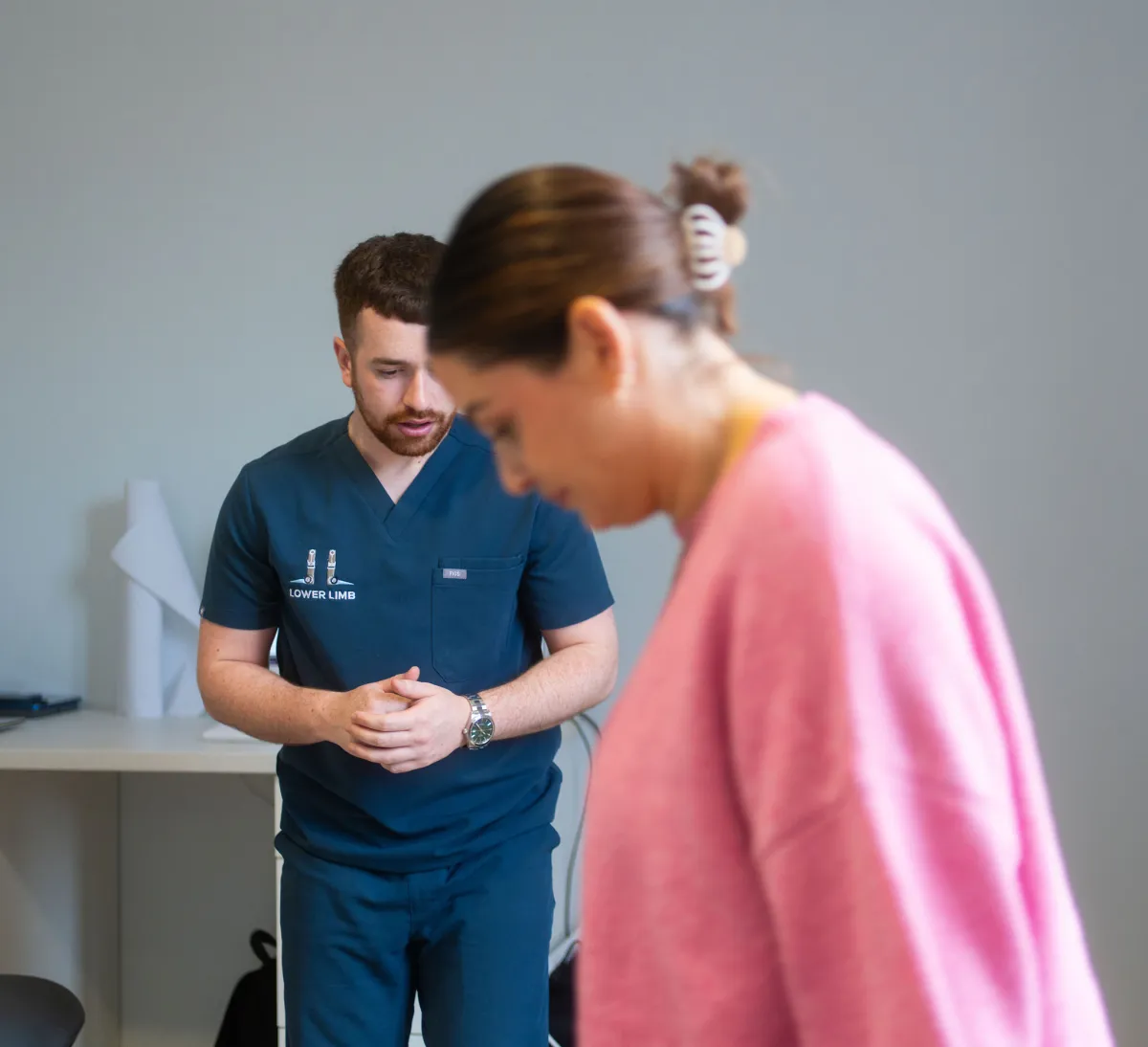
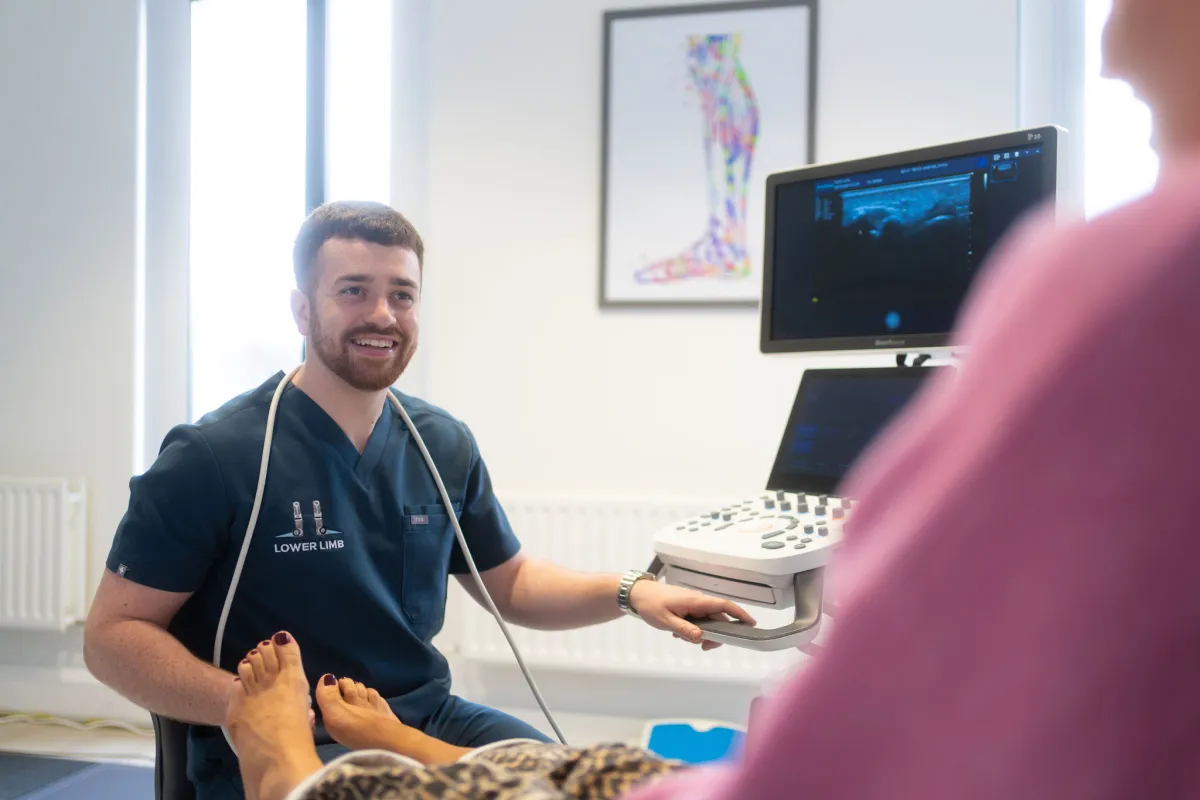
A full clinical assessment including strength testing of the hip abductors, single-leg balance assessment, and palpation of the ITB and surrounding structures. If we need to rule out other causes of lateral knee pain, diagnostic ultrasound is available in-house.
Step 2: Gait Analysis
Video gait analysis on our treadmill to assess foot strike, step width, cadence, hip drop, and tibial rotation. This gives us objective data on how your running mechanics are contributing to the problem.
Step 3: Treatment Plan
Based on what we find, a typical ITBS treatment plan includes:
- Hip strengthening programme: Targeted exercises for the gluteus medius and hip external rotators. This is the single most important intervention and the one with the strongest evidence base.
- Gait modification: If step width is narrow or cadence is low, small adjustments can significantly reduce ITB load. Increasing cadence by just 5-10% has been shown to reduce lateral knee forces.
- Custom orthotics: If foot pronation is contributing, orthotics reduce tibial rotation and change the loading pattern at the knee. Made in-house at Realta Labs.
- Shockwave therapy: For chronic or stubborn cases, shockwave can reduce pain at the lateral epicondyle and promote tissue healing.
- Load management: A structured return-to-running plan that gradually rebuilds tolerance without retriggering the problem.
Pain on the outside of your knee when running?
Do not keep running through it. Our sports podiatrists can diagnose ITBS and identify the biomechanical causes. Book your assessment online or call 028 9013 9185.
How Long Does ITBS Take to Recover?
With proper treatment, most runners are back to full training in 6-10 weeks. The initial focus is on reducing pain and starting the strengthening programme. Running can usually continue at a reduced volume if pain stays below 3/10, but this is assessed on a case-by-case basis.
The recurrence rate for ITBS is high when only rest and stretching are used. Runners who complete a full hip strengthening programme and address their biomechanics have a much better long-term outcome.
Running in Belfast With ITBS
If you are dealing with ITBS, a few practical tips while you are working through your rehab:
- Avoid cambered road surfaces where possible. The Lagan towpath and Comber Greenway are flat and even.
- Reduce hill running temporarily, especially downhill sections.
- If you run at Victoria Park parkrun or Ormeau parkrun, the flat terrain is preferable to hillier routes like Cave Hill or Divis.
- Cross-train with cycling or swimming to maintain fitness without loading the IT band.
About the Author
Paul McMullan is a specialist MSK podiatrist and founder of Lower Limb Clinic, Belfast, with clinics on Lisburn Road and Ormeau Road. He holds an MSc in Podiatric Sports Medicine from Queen Mary University of London and is a Fellow of the Royal College of Physicians and Surgeons of Glasgow (FRCPSGlasg).
Disclaimer: This article is intended for general informational purposes only and does not constitute medical advice. If you have knee pain or any running injury, please seek assessment from a qualified healthcare professional.