As Featured In
Golf Monthly. Paul McMullan, Lead Podiatrist at Lower Limb Clinic Belfast, was featured as a contributing expert in Golf Monthly's research article on golf shoe injuries and foot health.
Golf is one of the most popular sports in Northern Ireland, with hundreds of courses across Belfast, the North Coast, and County Down drawing players of every level. But while golfers invest heavily in clubs, lessons, and course fees, very few give serious thought to what they put on their feet, and it could be costing them more than just comfort.
Research highlighted in Golf Monthly suggests that wearing the wrong type of golf shoes can lead to chronic foot pain and lower limb injury. Our lead podiatrist, Paul McMullan, was featured in the article explaining why shoe structure matters far more than most golfers realise.
The Problem With Modern Golf Shoes
Over the past decade, the golf shoe market has shifted dramatically towards lightweight, trainer-style designs. Brands market flexibility and softness as premium features, and many golfers choose shoes based on appearance and initial comfort rather than biomechanical support.
The issue is that the golf swing places enormous rotational and lateral forces through the foot and lower limb. A full swing generates ground reaction forces of up to 1.5 times body weight, with significant torsional stress through the forefoot and midfoot. When shoes lack adequate structure to control these forces, the soft tissues of the foot absorb the load, and over thousands of repetitions per round, this can lead to overuse injuries.
What Injuries Can Poor Golf Footwear Cause?
At Lower Limb Clinic Belfast, we regularly see golfers with foot and lower limb problems that are directly related to their footwear choices:
| Injury | Cause in Golfers | Shoe Factor |
|---|---|---|
| Plantar fasciitis | Excessive strain on the plantar fascia over 18 holes | Insufficient arch support and heel cushioning |
| Morton's neuroma | Nerve compression during push-off phase of swing | Narrow toe box squeezing the forefoot |
| Metatarsalgia | Repetitive impact loading on hard ground | Inadequate shock absorption |
| Achilles tendinopathy | Tendon overload through the posterior chain | Low or flat heel profile |
| Knee pain | Excessive tibial rotation and patellofemoral stress | Poor rearfoot and midfoot control |
| Lower back pain | Rotational demands with inadequate ground stability | Soft, unsupportive midsole |
Recognise any of these?
If you're experiencing foot, ankle, or knee pain during or after golf, your shoes may be contributing. Our podiatrists can assess your footwear and biomechanics in a single appointment. Book online or call 028 9013 9185.
The 5-Point Golf Shoe Test
As Paul McMullan explained in the Golf Monthly article, golfers should prioritise a structured, supportive shoe over one that simply feels soft out of the box. Here's how to test any golf shoe in 60 seconds:
1. The Twist Test: Midfoot Stability
Grip the toe and heel of the shoe and try to wring it like a towel. If it twists easily, it offers almost no midfoot control, exactly where you need it most during the swing. Look for a firm midsole and a torsion control element between the heel and forefoot.
2. The Squeeze Test: Heel Counter Rigidity
Press the back of the shoe inward with your thumb. If it collapses easily, the heel counter is too soft to provide rearfoot stability. A firm heel counter keeps the calcaneus (heel bone) aligned and reduces excessive pronation during the walking and swing phases.
3. The Spread Test: Toe Box Width
Your toes should be able to spread naturally without being compressed. A narrow toe box is a primary risk factor for Morton's neuroma and can also aggravate bunions. Golf shoes should have sufficient width at the forefoot, particularly for players who walk 18 holes.
4. The Insole Check: Orthotic Compatibility
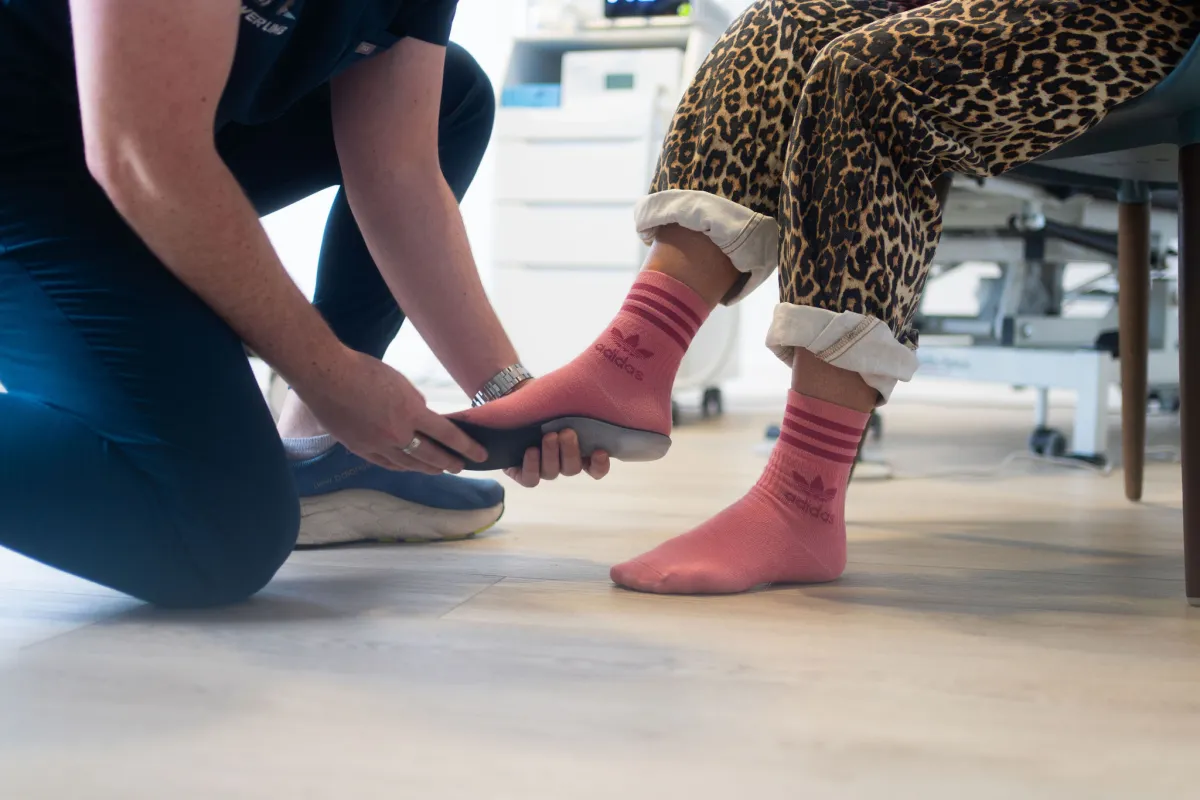
Remove the stock insole. Most are flat, thin, and offer minimal arch support. If you have any existing foot condition, or if you play more than once a week, consider replacing it with a supportive over-the-counter option, or ideally a pair of custom 3D-printed orthotics designed from your specific biomechanical data.
5. The Grip Test: Outsole Traction
Traction matters for both performance and injury prevention. Soft-spike or hybrid outsoles provide better ground contact than smooth or worn-down studs. Poor traction increases compensatory muscle activity through the foot and lower leg, which contributes to fatigue and overuse over a full round.
Quick summary: What to look for
A good golf shoe should resist twisting, have a firm heel counter, offer a wide toe box, accept a custom insole, and provide reliable grip. If your current shoes fail two or more of these tests, they may be contributing to your symptoms.
Do Custom Orthotics Help Golfers?
Absolutely. At Lower Limb Clinic, we see a significant number of golfers who benefit from custom orthotic insoles. Our orthotics are designed from pressure plate gait analysis data and manufactured in-house at Réalta Labs using SLS 3D printing technology.
For golfers specifically, orthotics can:
- Reduce plantar fascia strain with targeted arch support over 18 holes of walking
- Improve rearfoot alignment to reduce excessive pronation during the swing
- Redistribute forefoot pressure to offload painful metatarsal heads or neuromas
- Improve ground contact and proprioceptive feedback for a more stable base during the swing
Our orthotics are slim enough to fit inside any golf shoe and are designed to perform across multiple pairs of footwear, so the same pair works in your golf shoes, everyday shoes, and running shoes.
When Should Golfers See a Podiatrist?
If you experience any of the following, it is worth getting a professional assessment:
- Heel pain that is worse first thing in the morning or after sitting
- Pain in the ball of the foot, particularly burning or numbness between the toes
- Knee or shin pain that flares during or after a round
- Arch pain or fatigue that builds through the back nine
- Any foot or ankle pain that has persisted for more than two weeks despite rest
At our Belfast clinics on Lisburn Road and Ormeau Road, we offer comprehensive musculoskeletal assessments that include diagnostic ultrasound, biomechanical analysis, and gait assessment. No GP referral is needed.
Golfer with foot pain?
Our MSc-qualified podiatrists have specialist expertise in sports biomechanics and can assess whether your footwear is contributing to your symptoms. Book your assessment online or call 028 9013 9185.
Golf Courses Near Our Clinics
We regularly treat golfers from courses across Belfast and County Down, including Belvoir Park, Malone Golf Club, Balmoral, Shandon Park, Rockmount, Ormeau, and Knock, as well as golfers travelling from Royal County Down, Kilkeel, Warrenpoint, and the Mournes area.
About the Author
Paul McMullan is a specialist MSK podiatrist and founder of Lower Limb Clinic, Belfast, with clinics on Lisburn Road and Ormeau Road. He holds an MSc in Podiatric Sports Medicine from Queen Mary University of London and is a Fellow of the Royal College of Physicians and Surgeons of Glasgow (FRCPSGlasg). Paul was featured as a contributing expert in Golf Monthly's research article on golf shoe injuries.
Disclaimer: This article is intended for general informational purposes only and does not constitute medical advice. If you have foot pain related to golf or any sport, please seek assessment from a qualified healthcare professional.